
As motorcycle enthusiasts look for innovative ways to enhance their riding experience, integrating stereo systems into motorcycle fairings has emerged as a compelling customization trend. This approach not only enriches the audio experience but also preserves the classic aesthetics of the motorcycle. In this comprehensive exploration, business owners will gain insight into the integration of stereo systems, the advantages they offer, top products on the market, potential installation challenges, and practical guides to facilitate successful installations. Each chapter dives into essential aspects that illustrate the significance of this trend within the motorcycle industry.
Sound on the Move: Integrated Fairing Audio as a Core Motorcycle Customization Trend

Riders seek a riding experience that blends sound, design, and performance. Integrated stereo systems built into the fairing deliver high-fidelity audio at speed while preserving aerodynamics and weather seals. Model-specific enclosures align acoustics with the bike’s silhouette, reducing rattles and ensuring consistent sound at highway speeds. Weatherproofing, IP-rated connectors, and rugged harnesses enable reliable operation across rain and spray. Bluetooth and smartphone integration simplify pairing and keep cockpit clutter to a minimum, while steer-column or handlebar controls provide easy access to volume, track selection, and calls. Installation is typically done with pre-engineered kits or by professional installers to maintain the fairing’s integrity and resale value. The result is a cohesive cabin-like environment that respects the motorcycle’s identity and enhances the rider’s listening experience without compromising safety.
Sonic Armor on Two Wheels: How Integrated Fairing Stereos Elevate the Ride

The moment a rider slides behind a fairing that houses a purpose-built stereo system, the sensory landscape of the ride shifts. The goal is not to drown the engine and wind with volume, but to weave sound into the cockpit in a way that feels natural, controlled, and useful. A stereo system embedded in the motorcycle fairing provides more than entertainment. It creates a sense of immersion that can transform long stretches of highway into a more engaging experience, balancing the roar of the bike with music, navigation cues, and ambient sounds. The core idea is simple: dedicated left and right channels powered by a purpose-built amplifier deliver clearer, more defined sound than a generic speaker that’s merely mounted inside a fairing. The result is audio with depth, separation, and realism that can make music feel as if it comes from a small concert hall wrapped around the windscreen rather than from a couple of weather-resistant drivers perched in the plastic and fiberglass. For riders who spend hours on the road, this level of acoustic clarity matters. It suspends fatigue and helps maintain mood, which in turn can influence focus and overall ride satisfaction during long commutes or highway cruises. At its best, the system feels less like a gadget and more like an integrated feature of the bike’s geometry, designed to work with the bike’s lines, rider posture, and the acoustic character of the air around the fairing itself. The result is an experience that is more than mere listening; it’s a form of on-the-road ambiance that respects the vehicle’s dynamics while elevating the rider’s sensory world. A properly tuned stereo in a well-designed fairing can deliver the kind of warmth and spatial cues that help music breathe with the bike, offering a sense of space even when the throttle is open and wind is howling past the screen.
The components matter as much as the placement. A dedicated stereo amplifier drives independent left and right channels, enabling true stereo separation rather than a mono mix bolted into the fairing. This separation is not simply about louder sound; it is about depth and imaging. When the speakers are positioned with intention—typically angled toward the rider’s ears and protected from the worst of the weather—a listener experiences instrument separation, vocal clarity, and a stage that feels anchored in the cockpit rather than scattered across the surrounding air. Weather-resilient drivers, coupled with rugged crossovers, preserve fidelity in conditions that range from light rain to highway wind shear. In such setups, the acoustic tuning goes beyond the spec sheet. Engineers consider the volume of air behind the fairing, the internal cavity resonances, and even the back-panel geometry that shapes how sound propagates toward the rider. The idea is to tune the system so that a guitar’s strings ring out with warmth, a vocal line stays intelligible, and percussion lands with punch, all without sounding harsh once the bike hits highway speeds.
Sound quality on the move is not merely a matter of loudness. The fairing acts as an acoustic chamber, and good design recognizes that wind noise is not the only adversary. A well-integrated system uses damping materials, strategic air gaps, and sealed enclosures to minimize vibrations that would otherwise blur highs or smear bass. In practice, this means speakers mounted in weatherproof baffles with small internal cavities that enhance efficiency and keep the enclosure pressure stable as the bike moves. The speakers themselves are chosen not only for their durability but for their ability to deliver even response across a wide frequency range. The resulting mix carries the aggressiveness of rock or the subtleties of jazz with equal ease, so riders can tailor their listening experience to mood as well as terrain. Beyond music, such a system can incorporate smartphone integration and Bluetooth streaming, allowing navigation cues, podcast episodes, and hands-free calls to ride in concert with the engine. The rider remains in control, using handlebar-mounted interfaces to adjust volume, skip tracks, or switch input sources without taking hands off the controls. This is not just convenience; it is a safety-conscious feature, enabling the rider to keep eyes on the road while maintaining a connection to digital content that enhances the ride rather than distracts from it.
That integration extends beyond electronics to the architecture of the fairing itself. A growing number of pre-engineered kits bring together speakers, amplifiers, mounting hardware, and harnesses designed for specific model families. These kits simplify installation, reduce guesswork, and preserve the visual integrity of the fairing. They also align with weather protection and the fairing’s finish, offering factory-matched coatings or color-accurate trims that maintain the bike’s aesthetic cohesion. The idea is to blend function and form so the audio solution feels like a natural extension of the fairing’s original design rather than an afterthought tacked on later. The aesthetic considerations are not purely cosmetic. An integrated look reinforces the idea that the system is designed to endure the same stresses as the bike itself—from rain and splash to road salt and vibration. A well-conceived setup minimizes rattles, avoids interfering with other fairing components, and preserves the structural integrity that riders rely on when riding at speed through variable weather.
Power and reliability are the quiet guardians of this experience. A motorcycle’s electrical system must supply clean, stable power to a stereo without compromising charging, lights, or other critical functions. This means careful attention to power supply compatibility, proper fusing, and a tidy harness that avoids loose strands or loose connections that could corrode in foul weather. The electrical load is not enormous, but it is real, and neglecting it can lead to voltage dips that degrade performance or, in worst cases, trigger flicker in headlights or dashboard indicators. The installation process, while manageable for a skilled enthusiast, often benefits from professional oversight. A technician can verify that ground paths are solid, that the amplifier is adequately cooled, and that the bass is not overpowering the midrange, which would compromise speech intelligibility if navigation prompts or turn-by-turn cues are part of the setup. The balance between power, clarity, and reliability becomes a practical discipline, requiring iterative listening and careful calibration across riding conditions—city traffic, rural highways, and open-mreetop routes alike.
The practical value of integrated fairing stereo becomes most evident on longer journeys when riders lean into the journey rather than merely endure it. For commuters, the system offers a compact, weatherproof escape during daily rides. For highway riders, it becomes a companion that can accompany a timed, rhythmic rhythm of miles. The ability to customize the acoustic signature through tuning and digital processing allows riders to sculpt the experience. Some setups emphasize warmth and smoothness for pop or jazz, while others favor a crisp, precise high-end that helps distinguish the faint notes of a live instrument in a heavy wind environment. The choice depends on personal preference and the design language of the bike, but in every case the result is more than audio—it is a felt sense of immersion that aligns with the bike’s speed and posture, making the ride feel more responsive and personally owned.
Riders who already value a tailored ride often gravitate toward systems that offer compatibility with a range of fairings and model lines. This broad compatibility is why headlines in the aftermarket community emphasize not only the audio quality but also the ease of integration with popular fairing designs. A rider eyeing an upgrade can consult catalogues that list pre-engineered kits tailored to common bike families, knowing they will fit within the existing mounting points without compromising handling or aerodynamics. The approach to installation emphasizes preservation of fairing integrity—keeping mounts rigid, protecting against moisture ingress, and ensuring that any added mass is positioned to minimize sway at speed.
For readers seeking a tangible touchstone in fairing audio design, the broader market often points to practical, model-agnostic references to integrated audio solutions within touring and sport-touring lines. Such references underscore an important principle: the finest listening experience on a motorcycle is born from thoughtful integration, not sheer loudness. The end result is an acoustic environment that respects the rider’s safety, comfort, and sense of control while offering the corresponding benefits of entertainment and situational awareness refinement. In this sense, stereo-equipped fairings represent a synthesis of engineering and artistry, where sound is not simply heard but felt as part of the ride’s sensory fabric. The rider becomes immersed in a crafted soundscape that travels with the bike, tuned to fit the rider’s preferences and the bike’s dynamic character, yet resilient enough to withstand weather, vibration, and the open road.
For those exploring options, a practical first step is to consider the model family and the corresponding pre-engineered kit options available in reputable catalogs. This is particularly helpful for riders who want a seamless upgrade path that preserves the fairing’s lines and structural strength. The right kit will align with a rider’s power needs, weather resistance expectations, and aesthetic goals, delivering a solution that feels purposeful rather than improvised. As with any major modification, taking the time to listen to the system under different riding conditions—short hops, long stretches, and varying speeds—yields the best results. The road becomes the testing ground, not the showroom. When well executed, the result is a riding experience that not only entertains but also enhances the overall quality of the journey through sound that respects the bike, the rider, and the wind.
Internal link for model-compatible options: Honda fairings collection
External resource for reference on touring-oriented integration: https://www.harley-davidson.com/en_gb/motorcycles/standard/street-glide-ultra.html
Sonic Armor on Two Wheels: Seamless Stereo Integration for Motorcycle Fairings

The idea of adding sound to a motorcycle isn’t simply about turning up the volume. It’s about shaping an acoustic environment that respects the rider, the bike, and the aerodynamics that carry you down the road at speed. A fairing does more than cut wind; it forms an improvised listening chamber. When a stereo is properly integrated, the system becomes an extension of the bike’s design rather than a bolt-on afterthought. The best installations acknowledge this relationship, weaving speakers and electronics into the fairing’s curves so that music, navigation prompts, and hands-free calls feel like a natural part of the ride rather than a distraction.
The first challenge is to balance size, weight, and weather resistance without compromising the fairing’s function. Motorcycle fairings are built to manage airflow and protect delicate components from spray, dust, and temp swings. Add audio drivers, a waterproof enclosure, and a few meters of wiring, and the risk is not just cosmetic; it’s about maintaining structural integrity and predictable handling. The most durable solutions use sealed speakers with rugged grilles, weatherproof connectors, and mounting brackets that distribute vibration loads across the fairing’s framework. In practice, this means choosing drivers that can withstand harsh conditions and enclosures that prevent water ingress while keeping the internal acoustics optimized for rider-space dispersion. The goal is a sound profile that remains clear at highway speeds, where wind, engine thrum, and road noise all merge into a complex acoustic background.
With those physical constraints in mind, most riders encounter three broad approaches to fairing audio. One route favors an OEM-style concept, where the speakers and enclosures are designed to fit neatly into the lower portions of the fairing. The advantage is a seamless, factory-like appearance that preserves the bike’s lines and does not interfere with cooling intakes or steering geometry. A second path emphasizes modern connectivity, often combining Bluetooth-enabled modules with integrated fairing speakers. This approach yields flexible control via a phone or head unit, enabling streaming, calls, and navigation cues while maintaining a tidy, integrated look. The third option leans toward high-fidelity ambition. Brands and builders create custom mountings and waterproof enclosures for premium sound systems, aiming for wider frequency range, higher power handling, and refined dispersion patterns. Each route has its virtues, and the best choice aligns with how a rider intends to use the bike—daily commuting, weekend riding, or long-distance touring—and how much aesthetic versus performance matters to the owner.
The placement of speakers is more than a matter of space. It’s a careful exercise in dispersion and wind dynamics. The lower fairing often serves as an ideal mounting zone because it keeps drivers closer to the bike’s center of gravity, which helps reduce perceived vibration and cabling strain. But placement must also account for rider position. Sound should reach the helmet without becoming an echo chamber in the fairing or a distant, muffled response. That means selecting enclosures with proper sealing and internal damping that prevent rattles while still allowing the drivers to articulate bass and midrange with sufficient authority. The most successful installations balance a controlled bass response with crisp mids and highs so that wind noise and motorcycle thrum do not overwhelm the treble. When done well, the riders experience a natural soundstage that feels like it’s emanating from the bike itself rather than from a hidden box tucked away in a panel.
Connectivity and power are the practical lifeblood of a modern fairing audio system. Bluetooth streams offer convenience and flexibility, letting riders control playback, take calls, or receive navigation prompts without removing gloves or leaning into the dash. A robust system also anticipates the realities of motorcycle electrical systems: voltage fluctuations, ground loops, and the need for clean power during engine cranking. Consequently, designers favor interfaces that are isolated from the bike’s main power harness, with dedicated fusing, secure grounds, and short, shielded run lengths to protect audio fidelity. In addition, many installations incorporate weatherproof control interfaces—rotary dials, switches, or compact remotes—that survive heat, rain, and vibration. The end result is not just loudness, but clarity that persists when you’re fighting crosswinds or a roaring highway.
Sound quality, in this context, hinges on more than just bigger speakers or higher wattage. A thoughtful system uses digital signal processing and tunable crossovers to tailor the output to the rider’s space. DSP helps compensate for the fairing’s acoustics, smoothing frequency response, minimizing phase issues, and shaping the sonic image so that the bass stays tight and the highs stay clean even as RPM climbs and wind noise shifts. Waterproof enclosures and corrosion-resistant hardware protect those internals from moisture and road spray, ensuring the system endures season after season. This is where the line between luxury and practicality blurs in a satisfying way: the buyer who values musical fidelity is also the rider who expects reliability, not a delicate gadget that demands frequent maintenance.
Beyond hardware, the human factor plays a central role. Riders differ in how they want to interface with sound on the move. Some prefer a minimal, unobtrusive presence—an integrated system that sits invisibly beneath the fairing edges, delivering a clean, even sound. Others pursue a more immersive experience, with more pronounced drivers that fill the helmet’s airspace during long rides. Either path benefits from pre-engineered kits when available, because these kits are engineered around specific fairing geometries and electrical footprints, reducing the risk of misfit or electrical interference. The real value emerges when a rider finds a solution that respects the bike’s aerodynamics, preserves fairing integrity, and delivers audible clarity without demanding an expert-level installation. In those moments, the stereo becomes less about entertainment and more about a coherent, ride-enhancing system that supports long days on the road.
For riders with Honda-based configurations, the fairing’s mounting geometry and available space vary across models; see the Honda fairings collection. This is a reminder that the world of fairing audio is not one-size-fits-all. It rewards careful model-specific planning, an awareness of mounting points, and an appreciation for how a particular fairing shape channels sound. A well-chosen setup does not risk deformation, does not impinge on weather seals, and does not obstruct airflow. Instead, it sits in harmony with the bike’s lines and the rider’s posture, ensuring that the music seems to emanate from the bike rather than from a clumsy add-on.
The practical takeaway is that a satisfying fairing audio system starts with a clear vision of its purpose. Is the rider chasing subtle audio fidelity for long trips, or is the priority more about robust connectivity for calls and GPS prompts? Is the goal to preserve a factory aesthetic, or to push for heightened performance and a studio-like listening experience inside a helmet? Answering these questions guides the selection process toward the right architecture: an OEM-style installation for a clean, unobtrusive look; a Bluetooth-enabled configuration for versatile integration; or a high-performance, custom-fit system for enthusiasts who measure every decibel. Regardless of path, the best outcomes share a common thread: the components are integrated as an intentional element of the fairing, not an afterthought attached to a blank panel.
As with any thoughtfully engineered upgrade, the rider’s confidence grows when the system is reliable, weatherproof, and compatible with the bike’s electrical system and model-specific fairing geometry. The result is not merely sound; it is a harmonized enhancement that respects wind, vibration, heat, and rain while delivering a rider-centric acoustic experience. The road becomes a stage, but the stage is built into the bike, designed to survive the weather and the miles. The rider remains in control, with audio that supports orientation, comfort, and enjoyment rather than competing with wind and engine noise for attention. In this sense, stereo integration into motorcycle fairings transcends gadgetry. It becomes a nuanced conversation between form, function, and sound—a conversation that travels with you on every mile of your journey.
External resource: https://www.harley-davidson.com/en_us/motorcycle-audio-electronic-systems.html
Riding Sound: Navigating Space, Durability, and Sound Quality in Fairing-Integrated Installations

The appeal of stereo sound riding alongside the wind is undeniable. It promises a more personalized riding experience without sacrificing the sleek, integrated look that fairings provide. Yet the dream of a clean, factory-like audio installation collides with a hard reality. Motorcycle fairings are compact, high-speed environments where space, vibration, and weather conspire to challenge any audio system. This chapter explores the practical realities behind turning a fairing into a capable soundstage. It treats the installation not as a cosmetic upgrade but as a systems engineering challenge where every choice from mounting strategies to enclosure design, from power management to weather sealing affects performance, reliability, and rider safety. In this space, elegance comes from thoughtful compromise and meticulous planning rather than a flashy retrofit.
Space is the first constraint. A fairing interior is a three-dimensional puzzle of ribs, curves, mounting points, and channeling that channels air for cooling and aerodynamics. Any audio components must tuck into this geometry without altering the fairing profile or adding wind-induced turbulence that could erode stability or efficiency. The typical rider-friendly solution is to select compact drivers and a purpose-built amplifier that can fit within the available cavities without crowding controls or interfering with routing paths for critical wires. The result is a harmonized package where the speaker array sits in a position that preserves the rider’s line of sight to mirrors and gauges while aiming for a direct line of sound toward helmet ear level. This requires precise measurement, sometimes custom mounting brackets, and a willingness to accept less-than-baroque acoustics in exchange for a clean, reliable installation. The reality is that many installations hinge on a well-planned layout that respects the fairing’s geometry, balancing the need for sound coverage with the necessity of preserving aerodynamics and structural integrity.
Vibration is the constant adversary in a bike’s ecosystem. The road’s potholes, engine harmonics, and the fairing’s own flex all conspire to loosen components, degrade connections, and eventually reduce audio quality. A robust installation treats vibration as a design parameter rather than an afterthought. Components must be securely mounted using vibration-damping materials, such as rubber grommets, damping pads, and purpose-built mounts that isolate the speaker cone movement from frame-induced jostling. Wiring paths should be reinforced with clips, conduits, and strain reliefs to prevent chafing. A common pitfall is to underestimate the degree of vibration at highway speeds and in rough lanes, where even silicone-sealed connectors can fail if they are not properly anchored. The best practice is to integrate a rigid yet flexible approach: mount points that can tolerate movement without transferring it to the driver, combined with flexible, high-strain-rated cables kept away from hot engine zones and moving linkages.
Environmental protection is non-negotiable. A motorcycle exterior is a brutal, moist, and temperature-varying environment. Components that were designed for a showroom bench must endure years of rain, road salt, UV exposure, and rapid thermal cycling. Weather-resistant enclosures, sealed speaker housings, and corrosion-resistant connectors are not luxuries; they are the core of any credible install. Even small moisture intrusion can degrade the speaker’s voice coil, the amplifier’s damped heat sinks, or the DSP’s circuitry. The installation strategy, therefore, must include a reliable sealing plan, proper IP-rated enclosures, and waterproof connectors that remain dependable after repeated submersion and dry cycles. Temperature variance also matters: harsh heat in sunlit fairings can surge battery and amplifier temperatures, which in turn can trigger thermal protection modes or shorten component life. A thoughtful installer anticipates these cycles, placing critical heat-sensitive elements where airflow is possible and shielding them from direct sun exposure when feasible.
Sound quality in a fairing is less a miracle of high-end acoustics and more a disciplined exercise in acoustic reality. The internal cavity of a fairing is not a purpose-built listening room; it is a divergent, reflective space with hard, flat surfaces that can cause acoustic reflections and comb filtering. The rider’s ears lie behind a helmet and under a windscreen that acts as a feedback filter in itself. The result is a unique acoustic environment that demands directional, controllable sound sources and careful tuning. Directional or horn-like designs help project sound toward the rider without blasting the rider behind or out into the wind. A compact, well-chosen horn or directional driver can produce more intelligible speech and clearer music at highway speeds than a pair of generic drivers. Beyond placement, equalization and time alignment become essential tools. A compact DSP-enabled system can compensate for the fairing’s resonances, adjust for rider helmet acoustics, and tailor the sound stage to a rider’s preference. In practice, this means a practical balance: clean, intelligible audio that remains polite at high RPM, with a microphone-dense environment during calls or navigational prompts that does not overwhelm wind noise or crowd the rider’s awareness.
Power and wiring demands are often underestimated. The audio system adds a new electrical load that can strain a bike’s electrical system if not planned correctly. A robust installation begins with a careful assessment of the bike’s available power, including the alternator output and the battery’s reserve capacity. The key is to provide a dedicated, well-fused power feed that can bear surges when the system powers on or when the volume is ramped up during highway cruising. Wiring should be routed with care to avoid possible contact with moving components, edges of the frame, or heat sources. Shielded wires are advisable where interference is possible, and high-temperature-rated insulation helps maintain integrity in engine bay heat. A clean harness, clipped to hidden anchor points and protected by protective conduits, reduces the risk of grounding issues, EMI, and chafing. All these measures contribute to a quieter, more reliable listening experience that does not compromise the bike’s safety-critical systems, such as lighting circuits or brake wiring.
Safety and visibility remain central to any fairing modification. The goal is to preserve the bike’s stability and the rider’s safety margins. Speakers should not protrude into critical control zones or create blind spots for the rider. The mounting plan must consider crash dynamics and the potential for a loose component to become a projectile. Controls, such as volume or track selection, should remain accessible without requiring excessive attention away from the road. Weather seals and electrical connections must be resilient to rain and mud; the fairing’s structural joints must not be weakened by added hardware. The installer has to respect the fairing’s power-to-weight balance, ensuring the upgrade does not significantly alter handling, weight distribution, or center of gravity. In practice, this often means choosing lighter enclosure materials, compact amplifiers, and minimal but high-quality speaker systems designed for automotive or marine-grade endurance rather than luxury car catalogs, all while preserving the bike’s primary safety features.
Model-specific considerations and integrated approach. Model-focused resources help address geometry and mounting specifics of your bike. Pre-engineered kits tailored to particular models can simplify installation, improve reliability, and reduce the risk of compromising the fairing’s structure. When approaching a model-specific install, start with precise measurement of cavity depth, available width, and obstructions created by fairing vents or pedal assemblies. A well-mapped plan, combined with model-appropriate mounting hardware, yields a cleaner, more durable integration that looks like it was part of the bike from the factory. For riders exploring model-specific opportunities, the availability of dedicated fairing kits on manufacturer-aligned catalogues and aftermarket suppliers provides a practical path forward while preserving the bike’s integrity and performance.
An integrated approach balances the desire for rich rider-focused sound with the realities of space, vibration, weather, and safety. It requires a mindset that treats the fairing as a small, enclosed acoustic space rather than a flat panel that can easily hold full-size speakers. The outcome is a system that remains unobtrusive to the bike’s aerodynamics, robust against the elements, and tuned to deliver intelligible music, clear navigation prompts, and dependable Bluetooth or smartphone connectivity, all while staying within the rider’s safety perimeter. In practice, the best installations emerge from combining compact, purpose-built components with careful, model-informed mounting strategies, rigorous vibration damping, and thorough sealing. This integrated discipline is what turns a fairing into a functional soundstage rather than a risky afterthought. And it is what makes the rider feel it is not just music in the wind, but music that respects the road, the speed, and the rider’s attention to the road ahead.
For model-specific fairing considerations and compatible kits, consult model-focused resources and collections that address geometry and mounting specifics of your bike. These references can guide precise measurements, mounting options, and harness paths, ensuring the installation remains faithful to the bike’s design language while delivering consistent audio performance. As you plan, remember that space, durability, weather sealing, acoustic tuning, and power management are the pillars that determine whether an in-fairing audio system will be a seamless enhancement or a chronic maintenance concern. With careful attention to these pillars, the fairing can house a sound system that respects wind, ride, and safety while offering a soundtrack worthy of the ride.
External resource for deeper, space-conscious installation guidance: Fusion Apollo MS-RA800 Installation Guide. https://www.fusionmarine.com/Support/Manuals/FusionApolloMS-RA800InstallationGuide.pdf
Echo on the Edge: Designing and Integrating a Seamless Stereo System for Motorcycle Fairings
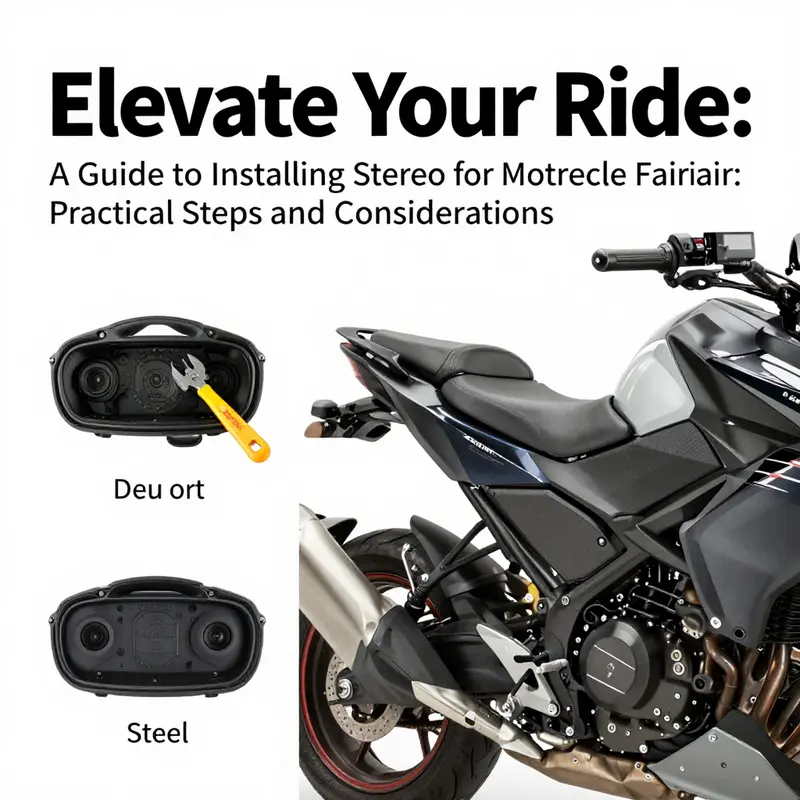
Riding with music is less about adding a speaker and more about shaping a listening environment that survives with you at highway speeds. A well-integrated stereo in a motorcycle fairing should feel like a natural extension of the bike, not an afterthought mounted to a dash. The goal is to create sound that travels with the rider, cutting through wind and engine noise without dominating the attention you must give to the road. This demands a careful blend of material selection, enclosure design, mounting strategy, and wiring discipline that respects both safety and performance. When done correctly, the result is not merely louder sound but clearer, more balanced audio that remains steady from the first morning ride to the last dusk cruise. The best installations depart from a simple add-on mindset and become a considered integration that honors the fairing’s aerodynamics, weather exposure, and the bike’s electrical system.
Planning starts with a sober assessment of the environment. Motorcycle fairings present a harsh arena: constant vibration, thermal cycling, wind-driven moisture, and a spectrum of temperatures from cool morning rides to sun-baked afternoons. Equipment must be rugged enough to withstand that environment while delivering intelligible audio at realistic listening levels. Look for components rated for IPX5 waterproofing or higher, and for shock resistance that can survive vibration and minor impacts without loosening or degrading over time. Power handling typically sits in a modest range—often a few watts per channel—to keep the electrical load within the bike’s charging capacity and to avoid stress on the charging system. Equally important is electrical compatibility. The system should integrate with the bike’s 12-volt DC architecture, ideally with a power management strategy that includes fusing, proper grounding, and a plan to limit the draw to a safe fraction of the electrical circuit’s capacity. These considerations are not merely about avoiding failure; they’re about preserving the bike’s reliability on long trips and in varied weather.
Choosing the right equipment for a fairing installation is a balance between size, weather sealing, and acoustic performance. Compact, sealed speakers paired with a small head unit or a weatherproof amplifier can deliver clean sound without intruding on the rider’s space. A compact head unit tucked away in a protected cavity or behind the instrument cluster reduces exposure to the elements and vibrations, while still offering essential controls and interfaces. If bass is a priority, a compact subwoofer can be placed where space and enclosure integrity permit, though this often requires more thoughtful enclosure design to avoid sacrificing boot space or cooling paths. The enclosure strategy matters as much as the speaker selection. Rigid, well-sealed enclosures with internal bracing minimize resonant rattles and ensure predictable bass performance even at higher road speeds. Acoustic isolation, achieved through vibration-dampening mounts and careful routing, helps prevent enclosure movement from translating into audible buzz or rattle. The primary aim is to maintain clarity across the frequency range so that dialogue and vocals in music or navigation cues remain intelligible without forcing the listener into permanent loudness.
Placement inside the fairing is rarely a single, perfect location. The fairing’s geometry, rider posture, and ego-less design all influence where speakers and controls can live. Some riders favor front-fairing positions for forward projection toward the rider, while others exploit side panels for broader dispersion or to keep lines clean and unobtrusive. The rear fairing or tail section often offers space that can accommodate a subwoofer or larger drivers, but it can also introduce enclosure challenges and weather exposure that require more careful sealing and protection. Whatever the configuration, the wires should be tucked discretely and routed along existing loom paths to minimize wear and heat exposure. Protective conduit or sleeving guards cables from abrasion, heat, and road debris. It’s essential to keep signal paths separate from power lines as much as possible, aided by shielded cables and proper strain relief at every junction. The goal is a tidy harness that can be serviced without cutting into the fairing or compromising its integrity. A practical reminder is to avoid obstructing cooling vents or airflow around the engine and electronics. Sound is one thing, but thermal and mechanical safety should never be compromised in pursuit of better audio.
Wiring is where theory becomes practice. The power circuit must be wired with an inline fuse placed close to the battery or main power source. A common approach is to fuse at a rating that protects the least robust component while allowing normal operation, typically within a modest amperage range. Grounding should be solid and dedicated. A clean, unpainted metal surface on the frame makes for a reliable return path, ensuring minimal hum and preventing ground loops that can manifest as audible buzz. Signal cables deserve their own protected route, kept away from heat sources like exhaust pipes and from high-motion components. Where saddlebags or fairing panels require crossing paths, use grommets and protective conduit. Every splice deserves proper insulation—prefer heat-shrink and durable electrical tape—to withstand vibration and temperature cycles. It’s advantageous to label wires during installation not only for the initial setup but also for future troubleshooting. The more systematic the harness, the easier it is to diagnose a fault while traveling or at a roadside stop.
Mounting the components is a choreography of restraint and resilience. The head unit benefits from placement behind the instrument cluster or within a dedicated cavity that remains shielded from direct rain and from the most aggressive vibrations. Use anti-vibration mounting methods, such as double-sided foam or purpose-made mounts, to dampen motion. Speakers need robust brackets designed to withstand acceleration, braking, and the occasional jolt from rough pavement. Even minor shifts can translate into misalignment, reduced soundstage, or rattles. Subwoofers, if present, demand a rigid mounting surface and a decoupled enclosure to prevent energy transfer to the fairing itself. The enclosure design should consider resonance control; internal baffling can help shape the bass response so it remains tight rather than boomy, which is particularly challenging in a small, curved fairing cavity. Weather sealing remains a constant requirement. Seams, mounting screws, and cable entries require gasketing and careful sealant choices to maintain protection over time.
Once the hardware is mounted, the tuning begins. Powering up the system for the first time introduces the real acoustic character of the installation. Left and right channels should be balanced, and the system should respond evenly to the controls. An equalizer or tone controls can tailor the response to the fairing’s acoustics and the rider’s preferences. Wind noise is a constant companion at speed, so the tuning strategy often relies less on brute bass and more on intelligibility and midrange clarity. A well-tuned system preserves vocal clarity and instrument detail, allowing critical cues—like navigation prompts or signals from nearby riders—to cut through without forcing the volume into the danger zone. Time alignment can also play a role in some installations. By electronically correcting for slight delay differences between drivers, the perceived imaging can improve, making the soundstage feel more coherent and centered on the rider. Real-world testing is essential. A short ride at moderate speed will reveal issues that bench tests cannot show: subtle vibrations loosening a bracket, wires rubbing a frame tube, or an enclosure flexing under pressure. If you hear buzzing, distorted notes, or intermittent signal drops, it usually points to loose connections, poor grounding, or a cable routed too close to heat or moving parts.
Maintenance is an often-overlooked part of the installation, but it is the key to longevity. Regular inspections should focus on seals around the speakers and head unit, the integrity of gaskets where wires pass through panels, and the condition of the harness insulation. Clean the external surfaces with a dry cloth to remove road grime and salt without introducing moisture into the enclosure. In winter, consider removing the system or storing it in a dry place if the bike will be unused for extended periods. Exposure to freezing temperatures and road salt can accelerate corrosion on connectors and metal mounting hardware. A proactive approach to maintenance keeps the audio system dependable and preserves the fairing’s overall integrity. The integration should remain a seamless part of the bike’s character, not a fragile aftermarket add-on that dictates how you ride.
To envision the broader significance, this kind of stereo integration is less about cranking volume and more about preserving a rider’s connection to the road. The best installations respect the fairing’s design language, protect the electrical system, and deliver sound that enhances riding without demanding attention away from the road. The result is a cohesive experience where music, navigation cues, and ambient sounds are perceived as part of the bike’s ecosystem rather than a bolted-on gadget. In exploring this topic, it’s valuable to consult practical references that cover technical fundamentals—like waterproofing, wire routing, and power management—and to compare real-world performance across installations. These insights help riders decide how far to push the concept, from modest, weather-tolerant setups to more elaborate configurations that maximize space and fidelity.
For readers seeking deeper guidance on installation specifics and performance comparisons, further resources can illuminate best practices and common pitfalls. Practical installation guidelines, protective measures, and performance tuning approaches provide a framework for thoughtful, repeatable results. As with any modification that affects a vehicle’s electrical system, patience and methodical work pay dividends in reliability and ride quality. This chapter aims to situate the stereo within a broader philosophy: sound should complement the ride, not complicate it. When planning your own fairing audio, imagine how the sound will feel at cruising speeds, where the wind and engine demand attention, and how the system can adapt to varying weather conditions across seasons. The fairing is a sculpted space designed to manage airflow and house components; the audio system, when carefully integrated, becomes a partner in that design, amplifying the rider’s experience without compromising safety or performance.
External resource for further guidance: https://www.motorcycle.com/motorcycle-accessories/audio-installation-guide/
Final thoughts
Integrating stereo systems into motorcycle fairings represents a significant shift in how riders experience their journeys. By enhancing audio capabilities while upholding the motorcycle’s aesthetic appeal, business owners have the chance to cater to a growing demand within this niche market. Understanding the benefits, exploring top products, tackling installation challenges, and following a practical guide can lead to fulfilling customer needs and driving success in the motorcycle customization business. It’s time to embrace this trend and offer riders an enriched audio experience that complements their passion for the open road.