
The 1960s cafe racer movement is deeply rooted in the fusion of style and function, with the nose fairing cowling at its heart. This article delves into the materials and design of these iconic cowls, illustrating how they serve both an aerodynamic function and a striking aesthetic purpose. In doing so, we will explore their impact on motorcycle performance and appearance, as well as the incredible journey of their evolution into modern interpretations that continue to celebrate this rich history. Overall, we aim to equip business owners with insights into consumer demands and trends surrounding these cherished motorcycle elements.
Between Wind and Steel: Materials, Form, and the Quiet Velocity of 60s Cafe Racer Nose Fairings
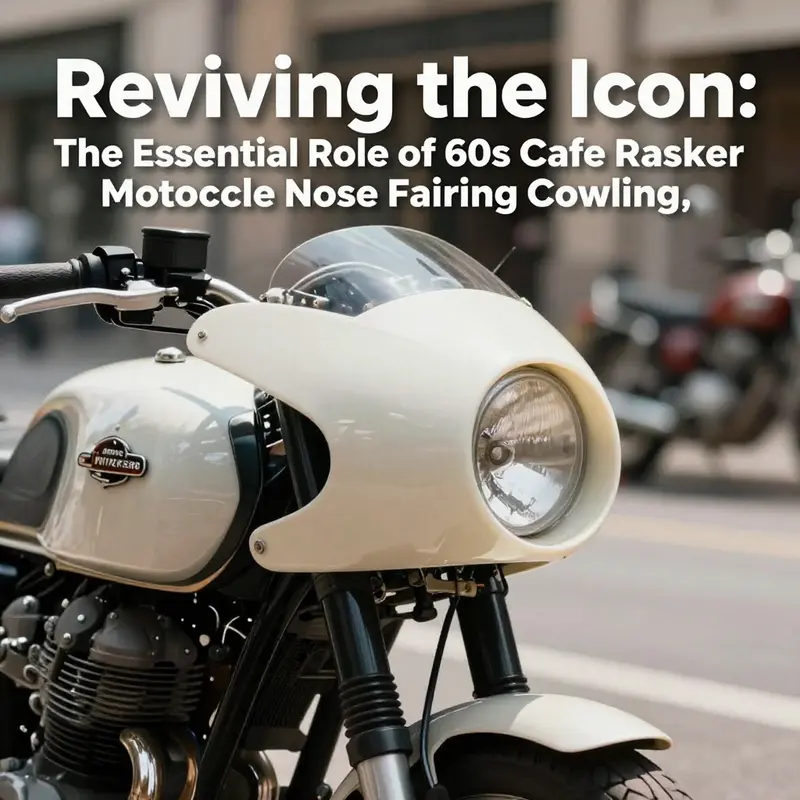
The nose fairing of a 1960s cafe racer is more than a shell: it is a design decision that blends air, rider posture, and machine attitude into a single, legible line. In the cafe racer ethos, the fairing aimed to cut wind with minimal distraction, wrapping around the front of the bike to create a forward-leaning silhouette that echoed the rider’s stance. Materials varied, with fiberglass offering lightness and shapeability, while aluminum and steel provided edge strength and durability. The choice of material influenced how the fairing interacted with the rest of the bike: fiberglass could be formed into smooth curves that kept weight down, whereas metal skins delivered crisp edges and a tactile sense of rigidity. The result was a front profile that looked fast even when the bike was stationary, a whisper of speed that framed the rider in a dedicated, purposeful stance. Modern restorations and tributes strive to honor these lines while incorporating contemporary materials and manufacturing methods, balancing authenticity with practicality. Whether reproduced or handcrafted, the nose fairing remains a core element of the cafe racer identity: a compact piece that speaks to speed, control, and the rider’s intimate relationship with the road. The broader design language, integration with the tank, and the knee indents guiding the rider into a tucked position all work together to support a riding experience that is as much about rhythm and balance as it is about raw power.
Streamlined Rebels: The Nose Fairing as the Design Pulse of 60s Cafe Racers
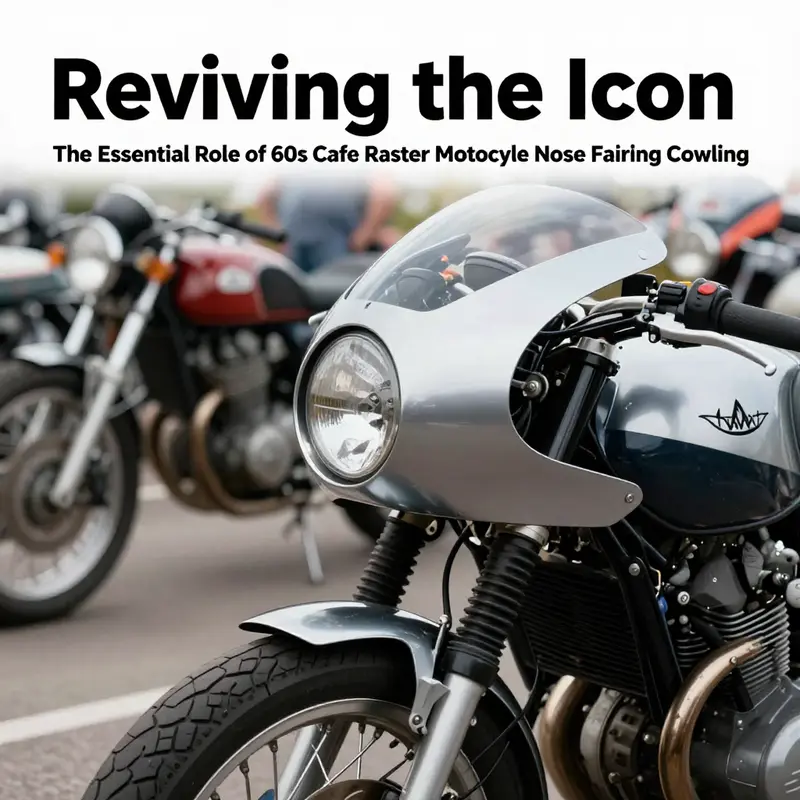
The nose fairing of a 1960s cafe racer is more than a front cover; it is a declaration. In Britain, where a culture of speed and improvisation grew from roadside cafés and windy country lanes, riders demanded a machine that looked as if it could slice through air itself. The nose cowling emerged as a deliberate fusion of form and function. It carried the rider’s gaze forward, not merely toward the road but into a future where pace and posture were the measure of a bike’s worth. This was a time when design did not merely adorn performance; it amplified it. The fairing’s elongated silhouette, the clean line where the front wheel and bodywork met, and the low, lean stance of the entire machine all spoke the same language: speed with intention, a rebellion against compromise, a compact statement that a motorcycle could be both practical and provocative at once.
From the outset, the nose fairing served a practical purpose that echoed the day’s racing ethos. The riders of those early cafe racers spent hours riding urban arterials and winding country roads, chasing a feeling more than a destination. The wind, unrelenting at speed, battered the rider and disrupted the bike’s stability. A well-shaped nose fairing redirected those forces, smoothing airflow over the fork crowns and head tube. It reduced buffeting around the rider’s helmet and lowered the effective drag coefficient enough to make high-speed cruising less taxing. In many ways, the fairing acted as a partner to the rider: it made the motorcycle feel surer and more composed when speed mattered most. In those years, any marginal gain in aerodynamics could translate into a meaningful advantage on a long, straight stretch or a sudden sprint between two coffee stops.
The construction of the earliest nose cowls reflected material limitations and practical constraints. They were lightweight, often crafted from fiberglass or simple metal forms that could be shaped on a bench without elaborate tooling. The shapes tended toward a simple, utilitarian elegance—a curved, uninterrupted surface that followed the bike’s front geometry. Attachments to forks or risers were straightforward, designed for quick installation and reliable operation on the road. The result was a rudimentary but iconic silhouette: a slim, elongated nose that visually extended the bike’s front end and harmonized with the low handlebar position that gave cafe racers their characteristic stance. The effect was more than visual; it was a coherent ergonomic philosophy. The rider leaned forward into the wind, but the air was caught and guided, making the whole machine feel tighter and more purposeful.
Aesthetics and performance arose in tandem, and the nose fairing became a defining feature of the era’s visual language. The elongated profile contributed to a perceived speed even when the bike was idling. The nose’s taper, the gentle sweep into the headlight opening, and the way the lines of the fuel tank and seat met the cowling created a single, uninterrupted line that read as a statement of intent. The classic cafe racer look—minimalist, almost Spartan in its restraint—was not a rejection of comfort but a choice about where effort should be concentrated. Weight savings, aerodynamic efficiency, and a visual grammar that signaled a rider’s serious commitment to speed converged in this single element. As a result, the nose fairing came to symbolize a whole attitude: resourceful, audacious, and unafraid to push the boundaries of what a motorcycle could be.
The narrative of the 60s cafe racer would be incomplete without recognizing how the nose fairing interacted with other key design cues. A low-mounted handlebar, an elongated fuel tank, and a compact tail section formed a cohesive chassis that prioritized control and agility over luxury. The front end had to blend form with function; it was the first line of defense against wind while also serving as a canvas for the bike’s particular character. The interaction between the fairing and the forks affected steering feel and balance, especially in quick transitions and at higher speeds. Small changes in curvature could alter the rider’s sense of stability; thus, the fairing’s geometry demanded careful consideration by the builder. Even in its simplest forms, the fairing communicated a philosophy: speed should feel like a natural extension of the rider’s body, not a separate force to contend with.
What made these early designs endure was their honesty. They did not rely on overt ornamentation or showy flourishes. Instead, the fairing’s line carried the bike’s entire poetry—the promise of highways, the thrill of a hard pull on a straight, and the intimacy of a ride where one could feel the road’s heartbeat through the bar and the seat. The appearance was not about looking fast; it was about being fast in a way that could be understood at a cafe table after a late ride. The aesthetic language was clean, efficient, almost architectural in its clarity. There was beauty in how the surface curvature responded to the rider’s line of sight, how the light grazed the nose and cast a slim, taut shadow along the bike’s profile. This is why the nose fairing remains inseparable from the cafe racer identity, a symbol of how form and function can fuse into a single driving purpose.
In practice, builders and riders of the era treated the fairing as a living system rather than a static shell. It was adjusted for each rider’s height, reach, and preferred posture. The skill of shaping the fairing was akin to tailoring a suit: the goal was to enhance the rider’s efficiency without pinching or fatigue. Small adjustments to the nose’s height or the windscreen’s angle could materially affect comfort during longer leg stretches and alter how wind pressure settled on the rider’s shoulders. The balance between aerodynamics and visibility was key. A fairing that blocked too much upward view could hinder navigation; one that offered a generous window for the rider’s helmet to breathe made the ride safer and more confident. In this way, the nose cowling acted as a mediator between the rider and the machine, translating the rider’s intent into a more stable, more controllable, and more exciting ride.
As the cafe racer ideology matured, the nose fairing retained its essential purpose while undergoing refinements. The shape grew more refined and, at times, more daring. Some iterations leaned into a slightly more aggressive profile, emphasizing a sharper peak that suggested speed even when stationary. Others pursued a more rounded, almost aerodynamic teardrop that would have reduced drag in wind tunnels. In all cases, the aim remained constant: to streamline the machine’s front end without compromising the machine’s character or the rider’s sense of identity. The fairing thus became a canvas on which the era painted its expectations for performance: speed with control, aggression tempered by practicality, and a design language that could be recognized instantly on a crowded city street or a quiet rural road.
Modern recreations of the 60s cafe racer nose fairing carry the same virtues forward. Contemporary builders and manufacturers approach the same geometry with new materials, tighter tolerances, and integrated components that the original era could not have afforded. Light alloys and reinforced composites allow for thinner, stronger forms that still echo the vintage silhouette. Aerodynamic analysis informs the curve where the nose meets the headstock, guiding airflow in ways that reduce buffeting and improve high-speed stability. Even when the goal is mere nostalgia, modern iterations seek to deliver the feel of a fast, responsive motorcycle while providing the reliability and efficiency riders expect today. The retro aesthetic remains a pulse that keeps the heart of the cafe racer beating, yet the bones beneath the skin have matured, becoming lighter, stronger, and more precise. The result is a fusion of heritage and engineering that honors the past while aligning with current performance standards. This balance is not an accident but a careful dialogue between two centuries of motorcycle design, a conversation about how speed is imagined and how it is realized.
In its essence, the nose fairing is a study in minimalism meeting purpose. The simplest shapes carry the most significance when they are well-aimed at a clear objective: to reduce wind resistance, to shield critical components, and to give the bike a silhouette that communicates intent even before the rider twists the throttle. The fairing’s surface becomes a story told in lines—where the nose begins, where it curves away, and how it engages with the rest of the chassis. It is easy to overlook how much a single curve can contribute to the bike’s perceived speed and to the rider’s experience. Yet every cafe racer from the era bears the imprint of this design logic: less is more when the design speaks directly to performance. The nose fairing, then, is not a decorative flourish; it is a working part of a whole that was engineered to satisfy both the eye and the nerve. The best bikes from that period feel light and agile, even when they are not the lightest on the road, because the fairing’s geometry was tuned to amplify the machine’s natural tendencies toward swift, precise handling.
For enthusiasts today, the appeal lies as much in the craft as in the outcome. Authentic or replica, the nose cowling is a tangible link to a movement that valued speed as a shared culture. Builders study vintage line drawings, measure fork radii with the care of an artisan, and test fitment with patient trial and error. The process can be as much about storytelling as it is about fitment: a fairing is a bookmark in a rider’s life, a reminder of late-night garage sessions, of the feel of a straight road and the sound of a tuned engine at the edge of its limit. When approached with respect, modern recreations honor the original’s raw mechanical poetry while offering the durability and consistency demanded by today’s roads. In this way, the nose fairing remains a living artifact—at once historical relic and ongoing source of inspiration for riders who want their machines to echo a time when speed was a personal declaration and a form of art.
For those seeking paths to authentic or replica parts today, the pursuit is less about copying a single shape and more about capturing a philosophy. It is about finding the same balance between lightness and strength, between minimalism and the rider’s human scale, and between a bike’s silhouette and its road manners. The nose fairing is a central piece of that equation. A faithful reproduction can make a cafe racer feel newly created, while a thoughtful interpretation can push the design forward without erasing its heritage. The work remains, in essence, a collaborative craft: engineers, metalworkers, and riders all contributing to an evolving dialogue about what speed means in a culture that once treated road racing as an urban ritual.
As the chapter closes on this exploration of form and function, the nose fairing’s enduring value becomes clear. It is not a mere accessory but a frame for a lifestyle—one that blends rebellion with refinement, urgency with restraint, and performance with personality. The 1960s cafe racer nose cowling stands as a timeless reminder that great design in motorcycles often begins at the front. It starts with the front, where air meets ambition, where lines are drawn with purpose, and where a single sparing curve can carry a whole story about speed, grit, and the road’s unknown possibilities. Riders today can experience that same thrill, whether they are cruising through city traffic or chasing a distant horizon on a wind-streaked highway. The fairing invites you to lean forward, listen, and feel the bike’s breath in your hands—a legacy that continues to shape how we imagine speed and how we design machines that move with it.
For readers eager to connect design history with practical restoration or customization, a closer look at current options can illuminate how the era’s ethos translates into modern form. While it is tempting to chase the look alone, the best results come from honoring the original’s intent: to optimize aerodynamics, to protect essential components, and to embody a particular rider’s stance. The nose fairing thus remains a bridge between decades, a hinge that allows the cafe racer to swing between the romance of the past and the precision of the present. It is a small piece of metal or fiberglass that, in its quiet way, tells a large story about speed as a shared human enterprise—one that survives beyond the era’s fashion to inspire ongoing exploration and invention in motorcycle design.
If you are curious about how this design detail translates into ownership experiences, consider the broader ecosystem of cafe racer culture, where builders source, adapt, and refine each element to suit personal taste and riding goals. The nose cowling is often the first piece a builder selects because it has the strongest visual impact and the most immediate aerodynamic payoff. Its presence signals intent: this is a bike built to move, to carve lines through air, and to express a particular way of riding. Even with modern materials and techniques, the fairing remains a direct line to the rider’s seat angle, leg position, and the overall geometry that determines how a bike behaves in a corner or on a highway straight. The conversation around the fairing is thus not only about aesthetics; it is a conversation about how a motorcycle can responsibly blend speed, control, and character. In the end, the nose fairing’s enduring appeal rests on its ability to make the rider feel both faster and more deliberate, a sense that, on the cafe racer, speed is a choice as much as a capability.
For those who want to explore further, the visual language of the cafe racer continues to evolve in new interpretations, but the core idea remains unchanged. A streamlined front end, a legible silhouette, and a posture that communicates purpose at a glance—these are timeless design principles that the nose fairing encapsulates. The chapter’s guiding insight is simple: the nose cowling is where speed begins, where mechanical efficiency meets rider confidence, and where history and innovation find common ground. In the café culture of the 1960s and in today’s modern custom scene, the nose fairing stands as a constant reminder that design can be both elegant and aggressive, a small surface with a big narrative that keeps accelerating with every new generation of riders.
If you are drawn to the tactile experience of restoration and the art of shaping, you might explore how a builder translates historical lines into a production-ready component. The best outcomes happen when there is clarity about how the fairing will interact with the bike’s frame, steering geometry, and the rider’s position. The lines should flow without abrupt interruptions, and the transition from nose to windscreen should feel inevitable, as if the air itself approves the contour. This is more than an aesthetic preference; it is a performance decision that can influence steering feel, front-end feedback, and the sensation of control at speed. A well-considered nose fairing helps the bike carry weight through a corner, reduces turbulence behind the fork tubes, and preserves the rider’s field of view, all while maintaining the provocative silhouette that defines cafe racer heritage. That heritage continues to be celebrated not only in old photographs but in the hands of builders who study those photographs, measure the lines, and aim to reproduce the magic with modern materials and engineering discipline.
For readers seeking a tangible path toward sourcing or evaluating nose fairings, consider how the choice aligns with both the bike’s intended use and the rider’s ergonomics. If the goal is a streetable homage that still feels connected to the original racing energy, a fairing with a modest extension and a clean, continuous surface can deliver the right balance of comfort and capability. If the objective is track-ready performance, a more precise shape and sturdier construction may be warranted, along with careful attention to mounting points and windscreen integration to minimize turbulence and maximize stability. The best outcomes blend respect for historical form with attention to contemporary standards of durability, fitment, and function. In that sense, the nose fairing becomes not a relic but a living component—an ongoing testament to a design ideal that continues to inspire riders to push the envelope while staying true to a shared sense of purpose and style.
In closing, the nose fairing cowling of the 60s cafe racer represents a moment when aesthetics and engineering converged to produce more than a machine. It created an ethos—a way of seeing speed that values efficiency, poise, and a certain stubborn elegance. The fairing’s shape is a shorthand for a culture that treated the road as a stage and the rider as a performer who could improvise with gear and geometry to extract maximum thrill from a few square feet of metal and plastic. Its influence persists in modern recreations that honor the old lines while leveraging modern techniques to improve reliability and ride quality. In that continuity lies the beauty of the 60s cafe racer nose fairing: a small, purposeful curve that helped shape a larger movement. It is a reminder that great motorcycle design often begins with a front view and ends with a rider’s sense of place on the road. For enthusiasts and historians alike, that history remains a touchstone—a guide to understanding how one humble fairing can carry the dreams of an era across decades and into the present.
For readers who want to connect this historical perspective to practical restoration and customization, a useful starting point is the broader catalog of cafe racer parts that honor the era’s aesthetic while offering modern compatibility. As you explore, keep in mind that the goal is not to replicate every detail exactly but to capture the spirit of the time: a bike that feels fast, balanced, and unmistakably confident in its stance. The nose fairing is a living symbol of that aim, an artifact of a culture that believed speed was a language and that good design could translate that language into a tangible, riding experience. When you stand before a vintage or vintage-inspired bike with a fairing that seems to whisper of the wind, you are witnessing the enduring power of design to shape not only how a machine moves, but how a rider feels in the act of moving. And that feeling, more than any particular finish, quickly persuades the eye and then the body to turn the key, settle into position, and let the road speak again.
To delve deeper into the historical evolution of this design detail, you can consult broader explorations of cafe racer heritage and its front-end solutions in reputable industry literature. Honda fairings collection offers a contemporary reference for the ongoing dialogue between period style and modern engineering. For a broader historical overview of the nose fairing’s development, see the external resource linked here: https://www.classicmotorbikemagazine.co.uk/features/evolution-of-the-cafe-racer-nose-fairing
Modern Interpretations of 60s Cafe Racer Motorcycle Nose Fairing Cowling
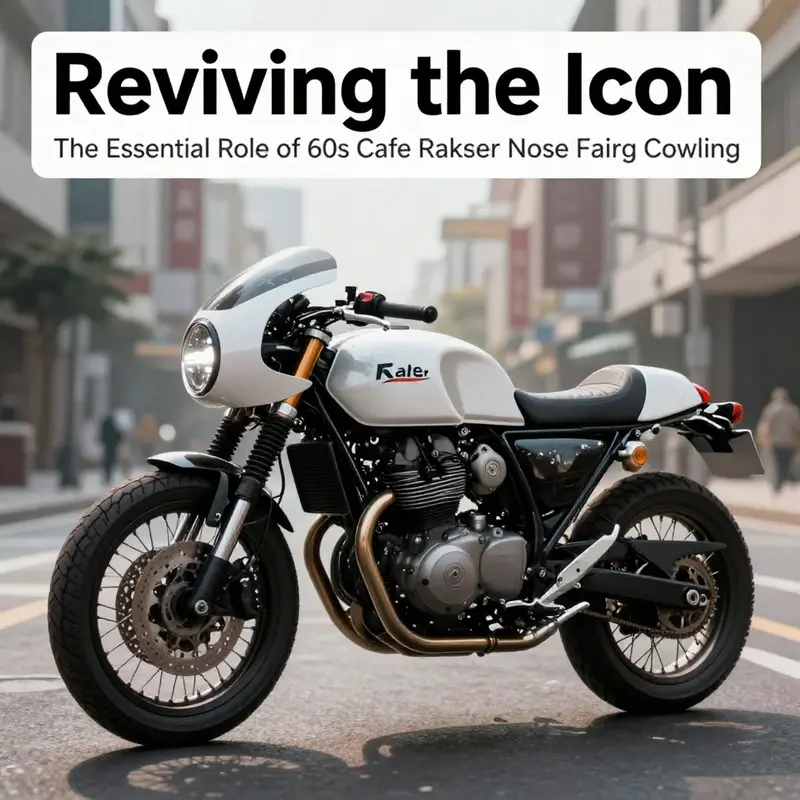
The nose fairing on a 1960s cafe racer is more than a shield against wind; it is a flagship of a design philosophy that married lean engineering with a rider’s fierce pursuit of speed. When modern builders look back at that era, they do not simply clone the silhouette. They reinterpret the lineage with materials, tolerances, and integration options that the originals could not have imagined. The result is a lineage that honors the past while doubling down on the present’s demands for efficiency, safety, and connectivity. In this chapter, we trace how contemporary interpretations of the iconic front cowling have evolved, and how those evolutions preserve the soul of the 60s cafe racer even as they push the form toward new horizons.
The classic cafe racer nose fairing is defined by its elongated, narrow profile that begins at the headlight, sweeps down to partially enclose the forks, and then continues along the frame’s lower edges. This shape achieves two essential ends: it minimizes parasitic drag at higher speeds and creates the clean, focused line that defines the cafe racer aesthetic. Modern recreations preserve that silhouette, yet the way the fairing is shaped and attached has expanded to serve a wider set of riding scenarios. Aerodynamic shaping today is less about a single moment of storming speed and more about a steady, controlled airflow that stabilizes the front end in urban environments, on winding back roads, and on longer highway stints. The improved wind management translates to reduced fatigue for the rider, better fuel efficiency in the case of internal-combustion models, and more consistent handling in the rain, crosswinds, and variable cross-sections of real roads. In this sense, the modern nose fairing is not just a cosmetic upgrade. It is a performance envelope that honors the past by trading some of the mid-century rawness for a more durable, predictable ride over a wider range of conditions.
To understand how the design evolves, it helps to consider the materials that define the modern era. The original fairings were often fiberglass or thin metal, chosen for their balance of weight, stiffness, and ease of fabrication. Today’s interpretations frequently deploy carbon fiber and reinforced polymers. Carbon fiber offers remarkable stiffness-to-weight ratios and a finish that carries a high-tech sheen while retaining a vintage gloss when painted in classic hues. Reinforced polymers, meanwhile, bring cost efficiency and manufacturability to scale, enabling more ambitious shapes, integrated storage solutions, and compatibility with contemporary mounting systems. The choice of material is not merely a matter of aesthetics. It drives assembly processes, maintenance cycles, and long-term resilience against impacts, heat, and UV exposure. A well-chosen material also harmonizes with the bike’s other elements—the headlight housing, instrument cluster, and the fork crowns—creating a coherent visual language that speaks to both the retro and the modern.
A defining feature of modern nose cowls is integration. The front end is no longer a detached shell slapped over the forks; it is a thoughtful ecosystem that includes lighting, instrumentation, and, in some builds, data-logging interfaces. Integrated LED lighting is now commonplace, offering crisp, compact illumination that can be tucked into the upper lip or the sides of the fairing where air is most efficiently managed. The lighting package can be paired with variable-beam patterns, daytime running lights, and even color-temperature adjustments that reflect rider mood or time of day. The fairing’s interior can house channels for air routing that direct a breeze toward the rider’s torso to improve comfort at speed while maintaining a slender outer profile. This fusion of form and function is a departure from the more austere, unadorned fairings of the early cafe racers but remains faithful to the principle of minimalism: less is more, even when the “less” is a more sophisticated system.
Bearing the weight of this evolution is the need to preserve the visual cues that signify a cafe racer’s lineage. The low, almost hunched riding position, the exposed engine peeking through the bike’s midsection, and the knee indents on the tank are all elements that the modern nose fairing must respect. Some contemporary fairings deliberately echo the “bullet head” aesthetic—an elongated, cylindrical feel around the headlight that exaggerates the forward thrust of the bike’s front end. In other instances, designers dial back the aggressive curvature in favor of a flatter, more Linear profile that aligns with the clean lines of the period. The balance between faithful reproduction and purposeful reinvention is a delicate dance. Enthusiasts today are often choosing between a reproduction kit that mirrors a specific 60s model and a hybrid fairing that borrows the silhouette but adopts more modern geometries and mounting strategies. The result is an ecosystem where the same design language can be tuned to suit a street bike, a track-oriented build, or a daily rider who wants the cafe racer identity without sacrificing practicality.
From a technological standpoint, modern nose cowls embrace telematics without overwhelming the bicycle’s vintage character. Digital instrumentation is widely compatible with retro-inspired dashboards that feature analog speedometers paired with digital readouts or full digital clusters that still echo the old-school dial aesthetics. GPS navigation, ride data logging, battery monitoring on electric models, and even telematics for fleet or club rides have all found a home inside or alongside the fairing. Of course, the integration is not about turning the bike into a data orb; it is about adding useful, seamless capabilities that respect the bike’s ergonomics. The mounting points for these systems are carefully chosen to preserve the fairing’s lines and to avoid compromising the rider’s posture. In many builds, the fairing’s inner surfaces are shaped to minimize turbulence behind the rider’s shoulder, reducing drag not only for the bike but also for the rider’s comfort.
The modern approach to authenticity is nuanced. It does not pretend that old fairings were perfect; rather, it acknowledges their limitations and offers enhancements that make the look livable in today’s traffic. Reproduction kits have become a formal segment of the market, offering indented knee grips on the fuel tank and streamlined seat cowls that hearken back to the original seat configurations while accepting more user-friendly seat cushions and mounting hardware. Yet even when vintage-replica aesthetics drive the design, contemporary builders often weave in modern hardware to improve ride quality and safety. Disc brakes, more sophisticated suspension layouts, and even planar or inverted forks can be married with a retro shell to deliver a safer, more predictable ride without erasing the historical cues. The result is not a museum piece but a living machine that can be enjoyed on modern roads and embraced by riders who might not have been around when the original café culture took off.
Aesthetics, ergonomics, and technology converge most compellingly when the fairing’s aerodynamics are tuned to real-world riding. Wind deflection is no longer a vanity metric; it translates into less fatigue over long commutes and better handling in gusty urban corridors. The elongated, tapered profile presents a clean front that channels air toward the sides rather than pushing it directly into the rider’s chest. Different fairing shapes offer different pressure distributions at various speeds, and intelligent design uses wind tunnel data to carve the most efficient contour for a given chassis geometry. For riders who clock many miles in mixed conditions, this translates into a more forgiving ride, with the fairing acting almost as a passive rider’s aid rather than a mere shell. The discussion of aerodynamics also extends to the bike’s undercarriage. With fairings that seal the forks and frame’s lower sides, air interacts with exposed components in a controlled way, reducing buffeting and minimizing the chance of front-end instability at high speeds or during sudden maneuvers.
Another layer of modern interpretation lies in customization and accessibility. The market now supports a wide range of aftermarket categories that enable personal expression without sacrificing the cafe racer DNA. Reproduction parts—when chosen with care—can preserve the essential silhouette, while the rider’s choice of color, finish, and hardware material personalizes the appearance. The fairing’s edges can be softened or sharpened to suit a particular rider’s taste, and the mounting hardware can be selected for ease of installation on a broad spectrum of chassis designs. The result is a dynamic dialogue between heritage and personalization, in which riders become co-designers of the machine’s face. The aesthetic is no longer a fixed point; it is a flexible standard that accommodates the creator’s hand while staying anchored to a recognizable ethos—the restrained, purposeful elegance of a 60s cafe racer.
In terms of compatibility with technology, the modern nose cowling is increasingly considered a platform rather than a single component. It is designed to host sensors, LED lighting, and instrument clusters in ways that minimize silhouette disruption while maximizing information and visibility. Some builders opt for modular fairings with removable panels, enabling quick customization with a few hand tools. Others deploy integrated storage or routing channels for cables, preserving a clean exterior and reducing the risk of snagging on loose wires during a ride. The contemporary approach is to treat the nose fairing as part of a connected, holistic bike system rather than as a stand-alone accessory. This mindset aligns with a broader shift in motorcycling toward ride-by-wire compatibility, smarter dashboards, and ambient lighting that responds to speed, weather, or time of day.
The broader cultural current around modern cafe racer fairings is leavened by a respect for authenticity that does not rigidly copy a single model but acknowledges a spectrum of influences. Some builders chase period-correct shading and surface texture, opting for matte enamel and pinstriping that nod to the period’s typography and branding aesthetics. Others favor a hyper-clean, almost industrial finish that speaks to today’s manufacturing precision. Either route—whether vintage texture or modern refinement—conveys the same message: the cafe racer’s nose fairing is a symbol of speed as intention, not merely a shield against the wind. The front end remains a statement of focus, an architectural gesture that announces to the world that the rider is leaning into the road with purpose.
For readers who want to explore how this philosophy translates into tangible builds, consider how a single design choice affects the entire machine. A subtle change in the fairing’s curvature can alter the rider’s perception of a corner’s entry, which in turn influences throttle response and braking balance. A choice about headlight integration can determine the bike’s weight distribution and its visual massing on the front end. Each element, from the indented knee grips to the fiber weave pattern on the outer shell, contributes to the story the bike tells at a glance. The modern nose fairing thus acts as a hinge between eras: it carries the craft techniques of the past, the performance know-how of the present, and a rider’s subjective sense of identity into a continuously evolving design conversation.
As we reflect on these developments, it’s helpful to acknowledge the role of reproduction and aftermarket ecosystems in making this heritage accessible. Enthusiasts who crave period accuracy can source parts that faithfully replicate the look, while others may choose to blend retro aesthetics with contemporary engineering—disc brakes, modern suspension, and even electric powertrains—so the cafe racer ethos remains relevant as traffic environments shift and technology advances. The balance between authenticity and practicality is not a compromise but a negotiation, one that allows the nose fairing to carry forward the soufflé-light elegance of the 60s while ensuring it remains resilient and usable in today’s riding realities.
In closing this overview, the nose fairing cowling of a 60s cafe racer is revealed not simply as a face but as a language. It speaks to a rider’s values—speed, control, and a clear line of sight to the road ahead—while also telling a broader story about how design can honor history without becoming a museum piece. Modern interpretations honor that dialogue by embracing new materials, embracing integrated technology, and embracing a broader, more accessible culture of customization. The result is a living aesthetic that respects the original’s spirit but grows with every turn of the wheel. For readers who want to see how these designs translate in practice, a few contemporary offerings and build stories can be explored through curated galleries and collections that highlight how the classic cues are reimagined in today’s manufacturing and customization ecosystems. For a sense of how mass-produced fairings have evolved in tandem with the cafe racer revival, explore the Honda fairings collection as a reference point for how a respected manufacturer translates retro silhouettes into modern packages. Honda fairings collection.
External reading can deepen the understanding of how trends in cafe racer nose fairings are developing across the industry. A comprehensive external resource that surveys current design trends and technical considerations offers a broader perspective on the topic. This outside article surveys the shift toward integrated lighting, lighter materials, and smarter ergonomics, and it situates the cafe racer’s nose cone within a wider conversation about how vintage-inspired motorcycles are meeting today’s performance and regulatory demands. You’ll find valuable context and examples that complement the themes discussed here: https://www.motorcycledesignhub.com/2025/cafe-racer-nose-fairing-trends.
Final thoughts
The nose fairing cowling is undeniably a cornerstone of the cafe racer identity, marrying aesthetic appeal with enhanced performance. Its evolution from simple shapes of the 1960s to sleek, modern designs illustrates the enduring legacy and adaptability of this motorcycle element. By understanding the nuances of materials, design principles, and the significance of functionality over comfort, business owners can better position themselves to meet the demands of contemporary motorcycle enthusiasts. The ongoing interest and investment in the cafe racer culture highlight not only nostalgia but also a desire for innovation—an opportunity for businesses to thrive.