
As motorcycle enthusiasts seek enhanced performance and comfort, air deflectors have emerged as a crucial accessory in the riding experience. These components not only improve aerodynamics but also provide significant benefits in terms of rider comfort. This article delves into the features and benefits of air deflector motorcycle fairing in smoke finishes, emphasizing their importance for business owners in the motorbike industry. Each chapter will explore the details of these products, from their technical installation aspects to current market trends and actual rider experiences, offering a comprehensive view of their value in today’s competitive market.
Flow, Shield, and Comfort: Mastering Wind with Smoke-Finished Air Deflectors
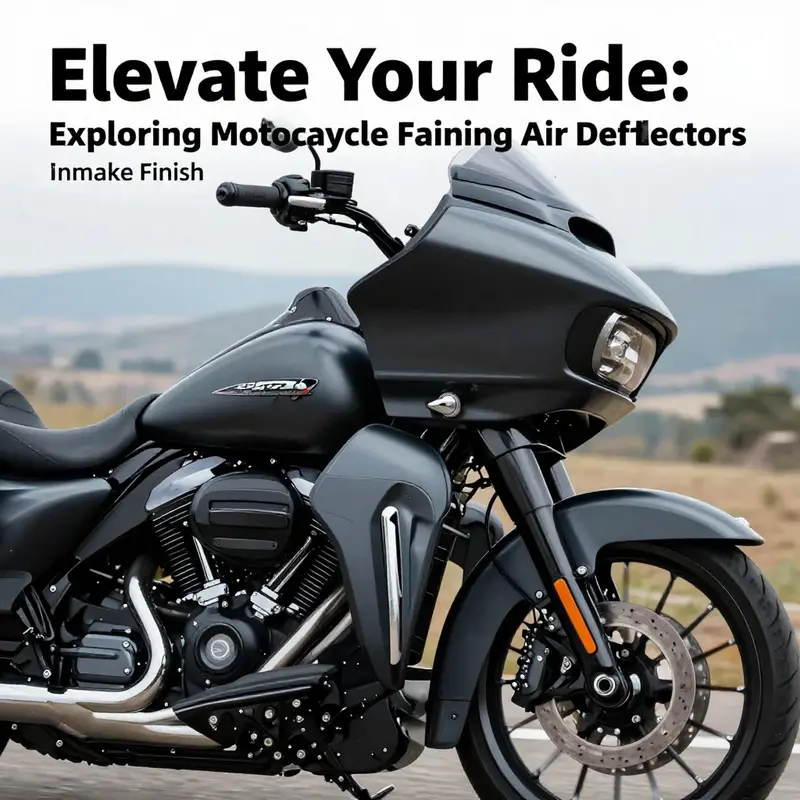
Riding into the breath of a moving landscape, a rider quickly learns that the wind is not merely an environmental factor but a companion on the journey. When a full fairing seals the rider away from direct gusts, it also creates its own set of air dynamics—turbulence around the elbows, draft along the arms, and a rushing sensation that can fatigue the neck, shoulders, and even the eyes after hours in the saddle. In this context, a smoke-finished air deflector integrated into the fairing becomes less a cosmetic add-on and more a finely tuned instrument. It is designed to manage the invisible air—to bend, soften, or redirect it so that the rider’s posture remains natural, vibrating at a lower frequency, and the helmet’s noise and buffeting are reduced. The finish itself—dark smoke—offers more than a gloss of style. It signals a design ethos that favors both function and form, a taillight of purpose in the otherwise anonymous shell of a touring fairing. The result is a calmer cockpit, where the rider can focus on line, tempo, and road texture rather than fighting the bike’s wind shadow.
The core feature at the heart of these deflectors is the infinitely adjustable friction pivot. This is not a simple hinge; it is a refined mechanism that gives you subtle, continuous control over the deflector wing’s angle. On a cold morning, when air rushing from the windshield can bite at exposed forearms, you close the vent and let the air slip around the fairing, turning a gale into a gentle trace along the outside of the bike. On a summer afternoon, when you need a cooling breeze riding across the chest and into the helmet’s intake, you open the vent and invite a controlled flow that slices through the stillness of the cabin. The ability to dial airflow in small increments translates into a riding experience that adapts to weather, speed, and terrain with a level of nuance riders intuitively rely on after thousands of miles of testing on asphalt and highway.
The dark-smoke aesthetic is not merely a darkened tint. It is a matte, resilient finish that minimizes glare and resists scratching in the kind of gravelly, long-distance tours where paint is tested by wind-blown debris and insect residue. The substance of the deflector—whether crafted from polycarbonate or ABS plastic—balances lightness with rigidity, ensuring that the wing keeps its shape at high speeds and under gusty conditions. The smoke finish thus works on two levels: it complements contemporary fairing lines and colors, and it contributes to a durable, long-term component that can survive the daily grind of maintenance, wash cycles, and occasional curb contact in a crowded garage. Aesthetics matter here not as ornament but as an extension of the bike’s design language. The deflector’s color and texture echo the fairing’s contours and the windshield’s edge, creating a coherent silhouette that looks like it belongs to the machine rather than an aftermarket afterthought.
From a mechanical standpoint, the deflector is built to connect securely to the upper fairing near the windshield, a junction that is both highly functional and aesthetically strategic. Mounting in this area means the air flow can be shaped before it passes over the rider’s arms and chest, where turbulence has the strongest impact on comfort and fatigue. The ride experience shifts as the airflow is smoothed. The deflector’s wing acts like a tiny, adjustable sail, catching and peeling off the wind so that it no longer converges into a single line of pressure along the rider’s torso. When wind pressure is redirected away from the body, the rider’s posture stays steadier, the shoulders drop naturally, and the neck muscles are spared the constant wringing tension that comes from bracing against buffeting. Helmets, too, benefit because the stabilized airstream reduces high-frequency vibrations that amplify wind noise and create a headache-inducing whine over miles of highway. The cumulative effect is a reductions in fatigue and a rise in sustained comfort, turning long sessions into something more akin to a measured, controlled glide rather than a constant battle with the wind’s random impulses.
The design language follows a similar logic of minimalism and performance. The air deflector is typically built to withstand UV exposure, temperature swings, and the occasional impact with road debris. The dark smoke finish contributes to a low-contrast aesthetic that integrates with most color schemes, from bold, saturated primary tones to the more restrained, metallic palettes seen on touring rigs. In practical use, the finish helps hide minor scuffs and micro-scratches that accumulate over time, preserving a clean look without demanding meticulous polish. Material choices like polycarbonate or ABS offer a practical balance between rigidity and impact resistance. Polycarbonate, known for its clarity and resilience, can maintain optical properties under sun exposure, while ABS provides rigidity and structural integrity. In combination, they create a deflector that resists warping, remains dimensionally stable at speed, and tolerates the temperature variations typical of a long ride through transitions from desert heat to high-country chill.
Beyond the raw mechanics and finish, the cultural and experiential aspects of air deflectors deserve attention. Riders value the sense of control that comes with being able to tailor wind exposure to their preferences. Some prefer a fully enclosed airflow to protect the forearms from the sting of wind on cold mornings; others want the wind to play a part in cooling the upper torso, controlling humidity around the chest and neckline. The adjustable deflector supports both extremes, and its openness or closeness becomes a tool in the rider’s repertoire for conquering weather without needing to compromise on speed or posture. In a sense, it is a micro-innovation that expands the rider’s agency over the ride itself. This is not only about comfort; it is about reducing fatigue to preserve focus, about keeping visual acuity reliable over long stretches at speed when wind noise can mask important cues from the road and traffic.
The installation philosophy is worth noting, not as a technical detour but as a design principle that respects rider time and confidence. These deflectors are intended to mount with relative ease, typically requiring only basic tools and minimal bike modification. The kit usually includes all necessary hardware, and the process is structured to be a straightforward integration with the existing fairing. In practice, a careful approach—planning alignment, confirming fitment with the vehicle’s model, and performing a test ride before finalizing the setup—yields a result that feels like a factory feature rather than an aftermarket add-on. The goal is for the rider to sense a coherent airflow relationship between the fairing, windshield, and deflector almost immediately, without the rough edge of a misaligned piece that catches air unpredictably or introduces new buffeting. As with any aftermarket fairing component, fitment accuracy matters. Some riders take advantage of fitment checkers or official guidance to ensure the part aligns with the fairing geometry and windscreen curvature. When this alignment is achieved, the deflector contributes to a smoother, more predictable riding environment across a wide range of speeds and riding styles.
There is also a broader ecosystem of fairing upgrades that this kind of smoke-finished deflector complements. While it is engineered for the needs of touring and sport-touring machines, its broader design philosophy resonates with riders who seek to harmonize aerodynamics and aesthetics. From a rider’s perspective, the deflector is more than a wind-slicing device; it is a deliberate choice about the kind of ride one wants to have. It signals a preference for controlled wind, reduced buffeting, and a cockpit that remains coherent and comfortable even after hours in the saddle. The ability to selectively open or close airflow can influence the sense of flight itself—how the bike feels at a given speed, how the rider’s body interacts with the air, and how the mind can settle into a steady rhythm rather than chasing turbulence.
In the larger tapestry of motorcycle customization, tools like this deflector illustrate a fundamental principle: small, targeted changes in the airflow can yield outsized gains in comfort and control. The smoke finish is not the sole attribute driving its value; rather, it is part of a holistic design strategy. The conversation about wind management moves from a purely functional debate about speed and acceleration to a more nuanced appreciation of ride quality, endurance, and rider health. Long journeys, cross-country routes, and highway commutes all benefit from a cockpit that remains calm and measured in the face of shifting air. A rider who can maintain a consistent torso angle, relaxed shoulders, and a neutral head position over many miles is better positioned to respond to road conditions, respond to traffic, and sustain a sense of purpose in the journey ahead.
For riders who want to see how this approach translates into broader fairing choices, it can be instructive to explore a wider catalog of fairings and their components. The Suzuki fairings collection, for instance, offers a spectrum of options that illustrate how designers approach fitment, aerodynamics, and finish choices across different models and riding styles. The takeaway is not that one brand or one part is universally superior, but that the principle of integrated airflow management—paired with durable finishes and thoughtful mounting geometry—yields a consistent, ride-improving result across platforms. By looking at how other builders and manufacturers articulate their own airflow solutions, riders gain a sense of the broader language of wind management and how to apply similar ideas within their own motorcycles.
As you consider upgrading or refining your setup, the practical path remains clear: assess the riding conditions you most often encounter, the typical road profile you face, and the weather patterns you expect to ride through. Then imagine how a smoke-finished air deflector could alter the wind’s map around your body. The adjustable wing offers a tactile feedback loop that helps you fine-tune comfort on the fly, turning constant buffeting into a controllable breeze. The finish, materials, and mounting geometry all converge to give you a component that feels like it belongs to the bike, not an add-on hung onto it. This is the essence of why riders invest in wind management: the reward is not simply reduced noise or less arm fatigue, but a more coherent relationship with the machine and the road, a sense that you and your bike are moving through air with intended purpose rather than fighting against it.
Engineering Precision: Installing Smoke-Finish Air Deflectors for Optimal Fairing Performance
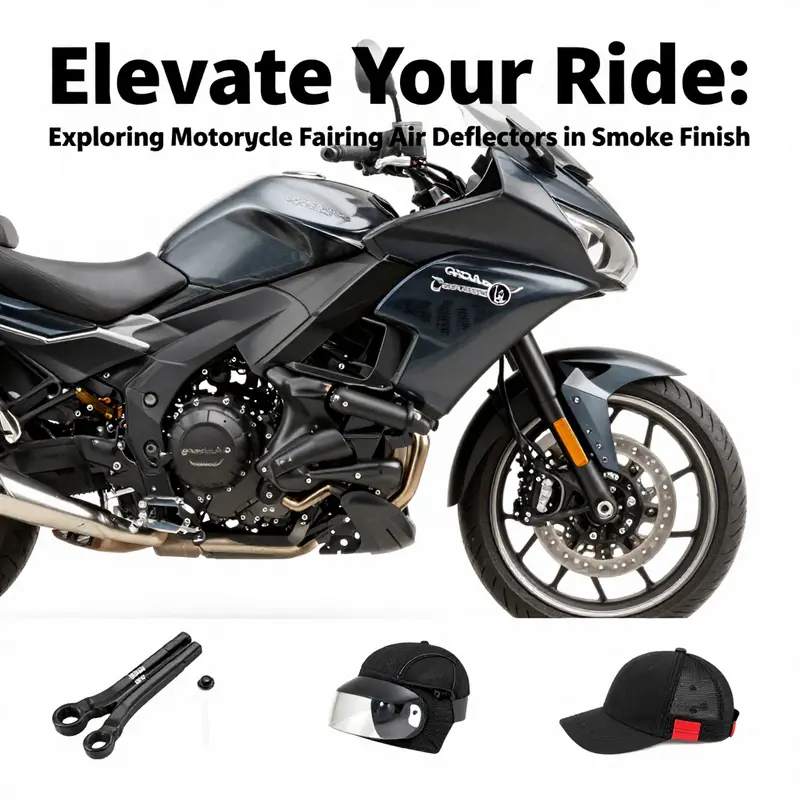
The installation of a smoke-finish air deflector transforms a motorcycle fairing from a static windscreen into a dynamic airflow management system. When riders select a dark smoke deflector, they commit to a component that must satisfy both aesthetic demands and engineering standards. Unlike simple bolt-on accessories, these deflectors feature an infinitely adjustable friction pivot that allows precise tuning of the vent angle. By opening or closing the vent, airflow can be channeled over the handlebars for cooling or redirected around the fairing to minimize turbulence on chilly rides. Achieving this balance relies on understanding material characteristics, fitment tolerances, and mounting best practices.
High-impact ABS plastic and polycarbonate are the primary materials in smoke-finish air deflectors. These polymers excel at resisting cracking under vibration and maintain structural integrity when exposed to UV rays. In a dark smoke formulation, pigment distribution must be uniform to avoid weak spots that could haze or yellow over time. To preserve optical clarity and toughness, manufacturers adhere to industry standards for impact resistance and heat deflection temperature. When you examine the deflector under bright light, the smoke tint should remain consistent and free from distortion. Material selection, therefore, is not just an aesthetic choice but a guarantee of long-term durability on open highways.
Fitment verification begins before a single tool touches the bike. Riders should consult official compatibility guides that list specific chassis codes and model years. For touring platforms, mounting locations are typically on the upper fairing, adjacent to the windshield. Precision gaps of just a few millimeters can influence airflow patterns dramatically. Too narrow a gap invites rattling and noise; too wide, and the deflector may flex excessively or even catch crosswinds at speed. By referencing manufacturer diagrams and part numbers, you confirm that the smoke deflector matches pre-drilled holes and fairing contours, ensuring a seamless integration with no post-installation surprises.
A well-organized bench setup includes the supplied mounting hardware, a torque wrench calibrated to the manufacturer’s specifications, thread-locking compound, and alignment shims if provided. The friction pivot system demands careful handling: overtightening can stiffen the adjustment mechanism, while loose bolts allow the deflector to shift under wind loads. Applying just the right torque value creates a firm yet rotatable connection, so the adjuster moves smoothly and holds its position without creeping. In many kits, mounting brackets are pre-assembled with captive nuts, streamlining the process to a few bolt-in steps—yet precision remains paramount.
Surface preparation dictates the quality of the final installation. Clean mounting points with isopropyl alcohol to remove oils and residue. Inspect the fairing’s inner surface for chips or deformations that could stress the deflector’s base. If factory paint is uneven or scratched, consider light sanding and repainting to ensure the mounting hardware sits flush. Installing on a flawless surface reduces the risk of stress concentrations that lead to cracking or loosening. When all mating faces are pristine, the components align naturally and bolt heads sit flush without gaps.
Begin the mounting sequence by loosely installing the bottom brackets, then pivot pins, and lastly the top clamps. This diagonal approach eases the deflector wing into its cradle, preventing binding. Hand-tighten each bolt in small increments, alternating across the assembly to maintain even pressure. Once all hardware is in place, apply the specified torque in a star pattern to avoid distortion. The friction pivot wing should rotate freely with measured resistance. Adjust the angle to your preferred position, then apply the final torque pass to lock everything in place. The result is a deflector that follows your commands without backlash.
After mounting, validate the deflector’s range of motion. Slide it through its full sweep from fully closed to fully open, checking for any contact with the windshield or fairing edges. Small misalignments can rattle at cruising speeds or even abrade the fairing surface over time. If interference occurs, loosen the mounting bracket just enough to tilt the deflector wing by fractions of a millimeter until full clearance is achieved. Tighten again and repeat the motion check. A correctly installed deflector will remain silent, even when buffeted by highway winds.
Maintenance of the friction pivot mechanism extends its service life. Periodically clean pivot surfaces with a soft cloth and mild solvent to remove dust and debris. Apply a light film of silicone-based lubricant to metal-on-metal contact points, avoiding excess that could attract grit. Inspect mounting bolts every few thousand miles for torque retention. As the deflector sees seasonal temperature swings and vibration, hardware can creep loose over time. A quick wrench check ensures that your deflector continues to operate smoothly and holds its trim angle under load.
From an aerodynamic standpoint, the smoke deflector’s role is twofold: reduce buffeting around the rider’s shoulders and minimize helmet lift. By fine-tuning the vent aperture, you can shift the high-pressure zone above the fairing to a low-pressure zone behind it, effectively smoothing the airflow curtain. When set to its narrowest gap, the deflector virtually extends the windshield’s profile, shielding cold winds. Open it to the widest position, and a controlled jet of air passes directly to the helmet, flushing heat and moisture on warm rides. This flexibility lets riders adapt mid-journey without tools, making the smoke deflector a truly active aerodynamic element.
Integration with other fairing components amplifies comfort and style. Riders who supplement half or full fairings with auxiliary windshields should account for added height and rake angles. The deflector’s pivot axis must remain level with the rider’s torso; otherwise, airflow will either bypass the helmet entirely or slam into the chest. In multi-component setups, always install the air deflector last. That ensures its settings compensate for any upstream deflection caused by the primary windshield or fairing inserts. When combined thoughtfully, these parts create a layered barrier that excels at managing wind noise and fatigue over extended rides.
Aesthetics play a significant role in component choice. The dark smoke finish lends a modern, stealthy appearance that pairs well with matte black fairings or brushed metal trim. To preserve the finish, rinse away road debris promptly and avoid harsh cleaners that can etch the tinted surface. For UV protection, apply a non-abrasive sealant designed for tinted plastics—this maintains color integrity and reduces the risk of surface crazing. By treating the deflector like your helmet visor or alloy parts, you sustain a showroom-fresh look long after the installation.
Common issues during installation stem from vibration, improper alignment, or the use of mismatched hardware. If you detect rattles at speed, recheck torque settings and consider adding thin vibration-damping washers between the deflector base and the fairing. Should cracks appear around mounting points, inspect the fairing for pre-existing stress fractures and replace any compromised brackets. Noise problems often resolve by adding a small rubber gasket under the pivot plate, isolating metal surfaces. In every case, careful inspection and incremental adjustments prevent minor complaints from escalating into component failures.
The ultimate goal of a smoke-finish air deflector installation is long-term reliability under diverse conditions. By respecting material limits, verifying fitment, and following precise mounting guidelines, riders achieve an installation that looks factory-original and performs without fuss. Routine checks and gentle maintenance keep the pivot action crisp and the tint clear, so every journey benefits from personalized wind management.
For detailed installation guidance and model-specific fitment checks, refer to the official product page: Harley-Davidson Adjustable Air Deflector – Dark Smoke
Shifting Gears: How Smoke-Finished Air Deflectors Are Driving Market Growth and Rider Comfort
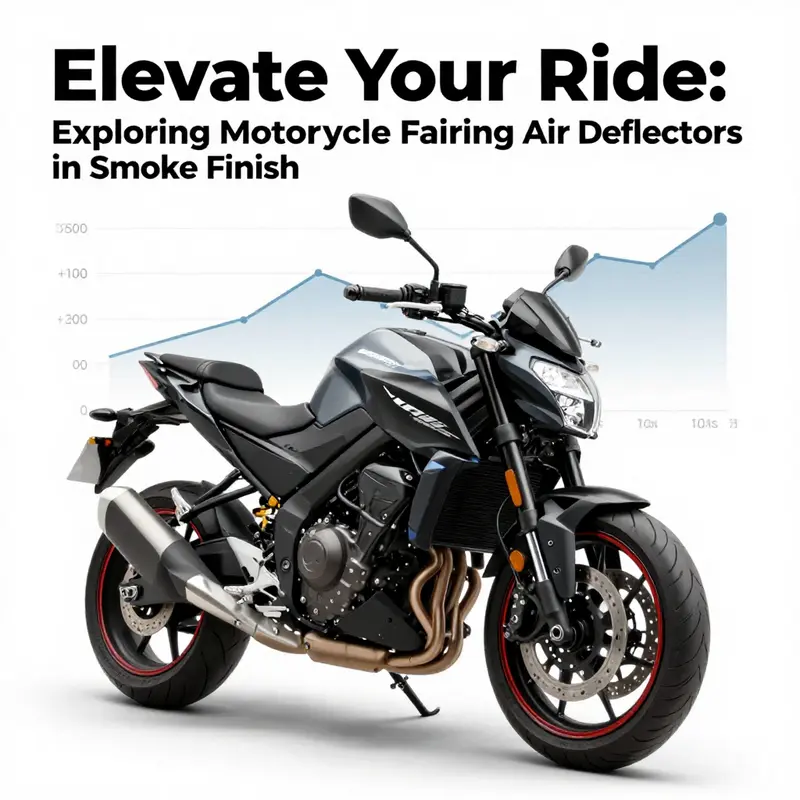
Market Evolution and Consumer Drivers
The landscape of motorcycle accessories has been quietly revolutionized by the advent of smoke-finished air deflectors. Once a niche add-on reserved for hardcore touring enthusiasts, these components have surged into mainstream demand as riders recognize the direct link between aerodynamics and comfort. In recent years, manufacturers and aftermarket specialists have noticed a steady uptick in queries, sales and social media buzz surrounding fairing-mounted smoke deflectors. The trend transcends model lines, appealing to owners of everything from sport tourers to heavyweight cruisers. This shift is propelled by a growing rider emphasis on personalized riding ergonomics and climate control. The ability to fine-tune airflow around the cockpit is no longer a luxury—it’s a sought-after performance feature.
As more riders embark on multi-state and cross-country journeys, the need to mitigate buffeting becomes critical. Smoke-finished deflectors complement windshields by redirecting gusts away from shoulders and helmets, effectively taming turbulence at highway speeds. Enthusiasts report reduced neck strain and a quieter cockpit, paving the way for longer days in the saddle without the usual fatigue. Dealers and accessory retailers confirm that sales of adjustable, smoke-tinted deflectors have outpaced many traditional fairing upgrades. This momentum is bolstered by peer recommendations on forums and ride groups, where real-world experimentation with vent positions has become a popular topic.
Industry surveys reveal that riders under 40 are particularly drawn to these accessories, valuing both the sleek, modern aesthetic of smoked plastics and the tangible performance gains. Adjustable mechanisms—often featuring friction pivots or infinite-angle sliders—allow for on-the-fly tweaks that respond to changing wind and weather. Whether a midwinter dawn ride calls for a nearly closed position to shield against biting cold or a high-summer blast demands a fully open vent for maximum cooling, these deflectors deliver versatility. The market is responding accordingly: product lines now offer a variety of smoke tones, from light smoke to dark smoke, catering to the aesthetic preferences of muscle-bike riders, touring aficionados and custom-build fans alike.
Simultaneously, regional nuances are shaping demand. In cooler northern climates, sales peak in early spring as riders prepare for the season and look for ways to cut through brisk crosswinds. In warmer zones, late spring sees a spike in orders aimed at improving airflow under scorching sun. Dealers report that bundles combining smoke deflectors with tinted windshields or vented handguards appeal to those building a full wind-management package. Even riders on smaller displacement bikes—once considered outside the core touring market—have begun installing scaled-down deflectors, acknowledging the benefits at highway speeds. This trickle-down effect signals that smoke-finished deflectors are evolving from premium touring accessories into ubiquitous performance parts.
Innovation, Materials, and Future Projections
Material science has played a pivotal role in propelling smoke-finished deflectors into the limelight. Early versions relied on basic polycarbonate or acrylic, susceptible to scratches and UV fogging. Today, high-grade ABS composites and scratch-resistant coatings ensure longevity and clarity for years of sun exposure. Manufacturing techniques such as injection molding and precision CNC trimming have reduced tolerances, yielding parts that fit seamlessly against fairings with minimal gaps. These refinements translate into less vibration-induced rattling and a near-factory look that integrates with a bike’s styling cues. The matte or satin smoke finish hides minor wear while offering a subdued contrast to glossy bodywork.
Beyond raw durability, manufacturers are exploring advanced compounds infused with UV stabilizers and anti-microbial agents to prevent fungal growth in humid climates. Some R&D teams are even experimenting with nano-textured surfaces designed to promote laminar airflow, pushing aerodynamic efficiency to new levels. While these developments are still in testing phases, they underscore a broader industry commitment to elevating what was once a simple vent into a high-performance module.
Meanwhile, the aftermarket ecosystem is thriving. Competitors vie to offer the most intuitive adjustability, whether through tool-free knobs, indexed detents, or patented pivot locks. Online retailers and specialist shops showcase demo videos highlighting quick installations and real-world performance tests. Enthusiasts trade tips on pairing smoke deflectors with complementary accessories—tinted visors, crash bars, or heated grips—to create the ultimate weather-adaptive ride setup. As a result, the accessory market around fairing aerodynamics has tripled in variety over the past five years, branching out from flagship touring models to include sportbikes, naked bikes and even dual-sport machines.
Global market studies project that this upward trajectory is far from slowing. Analysts estimate the air deflector segment will swell to approximately USD 16.95 billion by 2034, expanding at a compound annual growth rate of 3.45% between 2026 and 2034. The motorcycle-specific slice of this market will account for a significant share, driven by performance-oriented riders and OEM partnerships. Major touring-bike manufacturers are now bundling or offering optional smoke deflectors through their accessory catalogs, blurring the line between factory and aftermarket offerings.
Regional market forecasts further illuminate where momentum is strongest. North America leads in volume, reflecting a robust touring culture and widespread highway networks. Europe trails closely, with spikes in demand linked to long-distance routes such as the Alps and Trans-European motorways. Asia-Pacific markets, particularly in Japan and Southeast Asia, are emerging as growth engines, fueled by expanding disposable incomes and a vibrant community of sport-touring aficionados. Even in South America and the Middle East, where high-temperature environments pose unique challenges, riders embrace smoke-finish deflectors for both style and practical airflow management.
Beyond raw numbers, qualitative insights reveal evolving consumer priorities. Younger riders emphasize lightweight design and minimal electronic integration, rejecting bulky dash-mounted gadgets in favor of slim, aerodynamic wings. Meanwhile, experienced tourers demand reliability and modularity—features that enable quick part swaps during remote expeditions. These divergent needs are steering manufacturers toward modular accessory ecosystems, where smoke deflectors slot into universal mounting kits and share pivot assemblies with handguards or headlight masks. The result is a unified platform that reduces production costs and accelerates innovation cycles.
Amid this transformation, digital channels and online communities have accelerated adoption. Detailed installation guides, user-generated ride footage and ride-alike comparison tools allow prospective buyers to visualize deflector performance on their own models. Retail platforms now incorporate virtual fitment checkers—akin to a manufacturer’s compatibility tool—to help shoppers confirm whether a given smoke deflector will match their make, model and year. This integration reduces returns and enhances customer confidence, further fueling market expansion.
Looking ahead, the smoke-finished deflector category is poised for deeper integration with emerging technologies. Early prototypes featuring embedded air-pressure sensors promise real-time feedback on wind loading, feeding data to handlebar-mounted displays or smartphone apps. Such advancements could enable automatic deflector adjustments, creating a truly dynamic wind-management system. While these high-tech visions remain on the horizon, their mere prospect underscores the growing importance of fairing aerodynamics in the broader motorcycle experience.
The trajectory of smoke-finished air deflectors exemplifies how a seemingly simple accessory can reshape rider expectations and drive significant market growth. What began as a niche touring upgrade has evolved into a mainstream aerodynamic essential, valued equally for its functional benefits and visual impact. As manufacturers refine materials, expand adjustability and explore digital integrations, riders across the globe stand to gain enhanced comfort, reduced fatigue and a more engaging connection with the open road.
Rider-Centric Balance: How Smoke-Tinted Air Deflectors Transform Comfort and Aero Performance
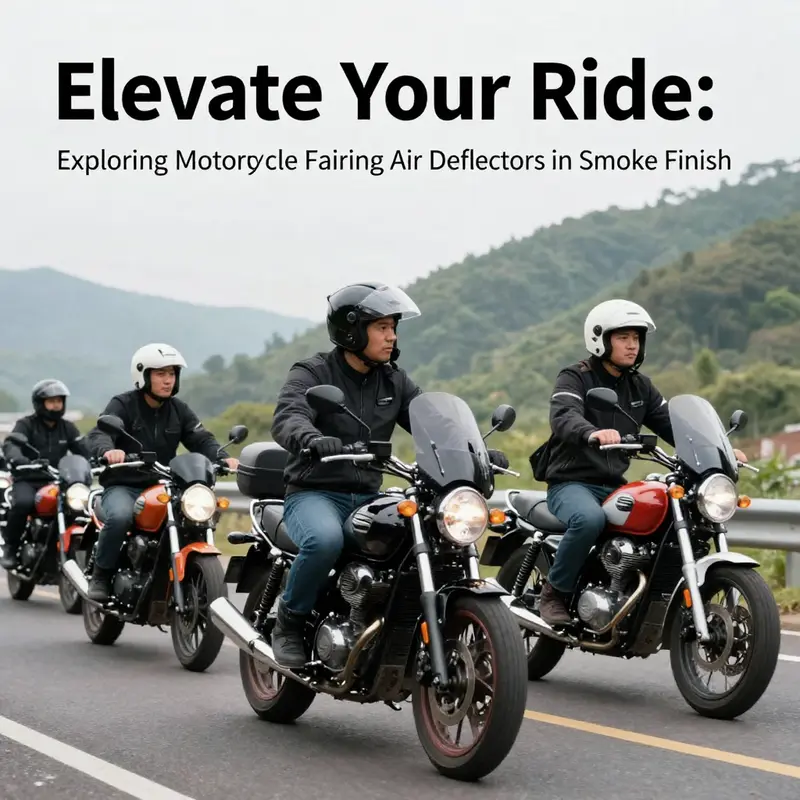
Riders frequently battle relentless wind buffeting on long highway stretches. A well‐designed smoke-tinted air deflector channels airflow around elbows and torso. By redirecting turbulent drafts, it eases shoulder tension and hand numbness. The result is a smoother, more controlled ride even at triple-digit speeds. Comfort improvements often translate to better focus and less fatigue. Riders report consistently more relaxed posture after fitting these deflectors. This direct, rider-focused innovation enhances every mile.
Beyond mere breeze control, smoke-tinted deflectors influence aerodynamic balance. Riders notice a more laminar airflow around the fairing cockpit. This smoother pattern reduces chaotic eddies that can push against the helmet and shoulders. The tinted finish, while adding style, plays no role in airflow performance. Instead, strategically shaped wings deform high-speed air, guiding it precisely where needed. The net effect feels like an invisible shield. With this stability, riders can hold lines with less steering correction.
Adjustable friction pivots allow minute control of deflector angle. Turning a simple knob alters the vent opening in seconds. Close the vent on cooler mornings to block cold drafts. Open it on scorching afternoons to invite fresh air in. This on-the-fly tweakability removes guesswork. Riders no longer compromise between ventilation and coverage. The mechanism’s robust design keeps settings locked under vibration. Confidence in adjustment reliability supports more aggressive riding.
Smoke-tinted variants offer a low-glare, matte aesthetic that matches most touring machines. The subtle veil over the plastic reduces visible scratches. Under sunlight, the finish hides fingerprints and swirl marks well. By blending with dark windshields and fairing panels, these deflectors appear as factory extensions. This integrated look pleases riders who value both function and style. Even bold paint schemes feel complemented by the darker tint. The finish choice thus marries durability with refined appearance.
Installation demands no specialized tools beyond the kit components. A straightforward fitment process takes under ten minutes per side. Riders align brackets with factory fairing holes, insert fasteners, then tighten finger-friendly knobs. Clear instructions help complete the task confidently. After mounting, there’s no need for further trimming or adjustment. The ease encourages many owners to update deflectors themselves. This do-it-yourself spirit adds satisfaction beyond the accessory’s performance.
Real-world feedback underscores these benefits. One rider on a coast-to-coast trip noted a 40 percent reduction in elbow buffeting after fitting smoke deflectors. Another praised the quieter cockpit on mountain passes, saying wind noise dropped from distracting roar to soft whisper. A touring enthusiast observed improved upper body warmth on autumn mornings, allowing later departures. These anecdotes highlight consistent gains across diverse climates and terrains. Collectively, they validate the deflector’s design goals.
Long haul comfort matters more when days blur into weeks. Riders report less cumulative fatigue on multi-day tours. By preventing constant arm pressure from turbulent air, deflectors reduce muscle strain. Even minor relief compounds over hundreds of miles. This improvement means more energy for exploring off-bike attractions. Slight weight shifts required to counter wind gusts become unnecessary. The freedom to maintain a natural posture encourages longer, more enjoyable journeys.
On chilly or blustery days, closing the vents creates a snug barrier. Air is channeled smoothly over the fairing and around the torso. Riders feel a stable pocket of still air behind the windshield. That trapped warmth helps fend off early morning chills. Heated grips and jackets work more efficiently under this protection. The combined effect feels like a light thermal buffer against cold gusts.
Conversely, in scorching conditions opening the deflector vents makes a big difference. Fresh air sweeps over the torso and down the arms. This targeted airflow feels cooler than helmet vents alone. Riders enjoy improved heat exchange without sacrificing wind protection. The adjustable angle directs air precisely to hot spots like chest and shoulders. This localized cooling can reduce sweat buildup during stop-and-go traffic.
Compatibility spans multiple touring platforms and model years. While Harley-Davidson Electra Glide and Street Glide riders lead the trend, many other touring bike owners follow suit. Sport-tourers and adventure bikes alike can find similar deflectors adapted to their fairing shapes. Those seeking updates for different chassis might explore aftermarket fairing collections. For instance, riders outfitting sportbikes often look to Honda CBR1000RR fairings to refine aerodynamics and style: Honda CBR1000RR fairings.
Beyond comfort, these deflectors deliver secondary performance gains. Smoother airflow reduces overall drag by minimizing turbulent pockets. Some riders report fractionally improved fuel efficiency on long highway runs. The calmer air environment also lessens helmet buffeting noise. Fewer sudden wind pressure shifts mean a more stable head position. This stability reduces neck fatigue during extended high-speed stretches.
Noise reduction goes hand in hand with airflow management. By softening the roar of wind hitting helmet and jacket, deflectors lower perceived decibel levels. Riders no longer need to over-amplify intercom volumes to overcome noise. Conversations with passenger and coach communications become clearer. This quieter cockpit increases situational awareness. Riders can hear subtle traffic cues and ambient noises more easily.
Fuel economy improvements are modest but welcome. With less drag, fuel burn on highway segments can drop slightly. Over thousands of miles, minor savings add up. Riders tracking mpg before and after report gains of up to one mile per gallon. While that seems small, it translates to dozens of dollars saved over a touring season.
Aesthetics play a surprisingly big role in user satisfaction. The dark smoke finish blends seamlessly with tinted windshields and blacked-out trim. This cohesive look appeals to riders seeking a stealthy, aftermarket style. When installed correctly, deflectors appear as if they came from the factory. No visible brackets or mismatched shades distract from the bike’s lines. This clean result boosts owner pride and positive feedback from fellow riders.
Fitment concerns vanish when products follow strict OEM specifications. Precision-molded ABS plastic matches fairing contours precisely. Holes align without filler or sealant. Knobs and pivot arms sit flush with the fairing surface. This precise fit prevents rattles and unwanted movement at speed. The result feels as solid as a non-adjustable panel.
Considering cost versus benefit, smoke-tinted deflectors represent excellent value. The modest purchase price delivers repeated comfort dividends. Riders avoid fatigue, numbness, and tension on long rides. They gain noise reduction, slight drag improvement, and sleek styling. This well-rounded package outperforms many single-function accessories.
Integration with existing fairing accessories remains smooth. Deflectors work alongside trip computers, light bars, and windshields. They occupy minimal fairing real estate near the windshield base. Their pivoting wings clear other mounted items effortlessly. Riders can preserve all existing gadgets without compromise.
In everyday use, these deflectors require nearly zero maintenance. Occasional cleaning keeps the matte finish looking pristine. The robust plastic resists weather, UV, and grit. After several seasons, many riders report no structural wear. The friction pivot mechanism remains firm and reliable without re-greasing.
Even after years of service, riders continue praising the upgrade. Many cite the initial installation as a turning point in their riding enjoyment. Overloaded touring bikes feel more manageable at speed. Commuters no longer dread wind-driven fatigue. From long-distance adventurers to daily ride enthusiasts, the consensus is clear: smoke-tinted air deflectors deliver measurable comfort and performance improvements.
For a closer look at one popular solution and detailed specifications, see the official Harley-Davidson overview: https://www.harley-davidson.com/uk/en/accessories/air-deflectors/light-smoked-fairing-air-deflector.html
Final thoughts
Air deflector motorcycle fairing smoke products represent an essential investment for both riders and business owners in the motorcycle industry. By understanding the features, installation techniques, and user experiences surrounding these accessories, business owners can better meet customer needs and enhance overall rider satisfaction. As the market trends reveal increasing demand, offering high-quality air deflectors will not only improve ride comfort but also elevate the competitive edge for businesses in this vibrant sector.