
In a competitive landscape where cost-effectiveness and quality are paramount, understanding the cheapest motorcycle fairings can significantly benefit business owners in the motorcycle accessory market. This article delves into current trends, materials utilized for affordability, market comparisons, and valuable insights from consumers, providing a comprehensive overview for those seeking to optimize their offerings. Each chapter builds upon the last to equip business owners with the knowledge to make informed decisions that align with consumer needs and market trends.
From Dirt-Cheap to Durable: The New Wave of Affordable Motorcycle Fairings

A steady shift is unfolding in the market for motorcycle fairings, and it is not just about prices dipping to the floor. The cheapest options are no longer synonymous with compromises in performance or protection. Instead, the landscape has matured into a balanced equation where cost, durability, and aerodynamics are measured more thoughtfully than ever before. What looks like a bargain at first glance is often a carefully engineered solution that leverages modern materials, smarter manufacturing, and smarter buying decisions. The result is a range of budget-conscious fairings that can noticeably improve ride quality, fuel efficiency, and engine cooling—without forcing riders to forgo style or reliability.\n\nCentral to this evolution is material science. ABS plastic has become the lingua franca of affordable fairings, favored for its resilience in impact, UV resistance, and versatility in mass production. It is not exotic, and that matters. For riders on a budget, the availability and predictable properties of ABS mean parts can be manufactured at scale, with consistent thicknesses, ribbing, and wall angles that reinforce the shell where it matters most. This is a critical shift from earlier eras when low prices often meant thinner plastics that cracked under a sharp impact or faded under sun exposure. Today’s budget options, while still cheaper than high-end composites, stand up to the daily realities of riding, storage, and highway exposure. Moreover, ABS is compatible with common painting and finishing processes, allowing finishers to achieve a look that, while not carbon fiber, can still feel intentional and premium on the bike’s silhouette.\n\nThe manufacturing backbone of these advances is increasingly decentralized and highly integrated. Regions known for large-scale plastics production and injection molding—especially in large manufacturing hubs—have developed capabilities that make it possible to produce complex fairing shapes quickly and with tighter tolerances. The result is a broader spectrum of options for different bike archetypes—from sport-oriented machines to touring platforms—without requiring owners to accept a one-size-fits-all shell. This is the practical edge of globalization: a factory can churn out precise, model-adapted fairings in short cycles, then ship them to riders and retailers worldwide. In this context, the appeal of affordable fairings is less about clever marketing and more about repeatable fit, predictable color outcomes, and the ability to match or complement an existing chassis with a minimal gap at mounting points.\n\nA parallel development shaping affordability is the rise of custom and aftermarket designs tailored for popular motorcycle archetypes. Rather than a single generic shell, suppliers now offer a spectrum of variants that address specific rider needs—ranging from full fairings that maximize wind protection to lighter, sportier ensembles that emphasize airflow and weight distribution. Modern injection molding enables these variants to emerge from the same regional supply chains with differences in ribs, inner liners, and mounting brackets. When a rider chooses a component designed for a particular model family, the installation experience can become straightforward rather than a project that requires extensive trimming and drilling. This trend toward precise compatibility is not just about aesthetics; it reduces installation time, minimizes the risk of interference with controls or the radiator, and often eliminates post-purchase modifications. The upshot is that budget-conscious buyers gain confidence that their new fairings will fit without the need for epoxies, brackets, or hacks that could compromise safety.\n\nValue, at its core, is about what a rider gets for every dollar spent. Complete fairing kits—often priced under a hundred dollars—now commonly include not just shells but a suite of accessories that streamline the upgrade. Mirrors, mounting hardware, and sometimes even small trim pieces can be bundled with the main shell, turning what could have been a disjointed upgrade into a coherent, install-friendly package. This bundling matters. It removes the friction that normally deters budget-minded riders from pursuing a fairing upgrade—namely, the fear of missing hardware or incompatible mirrors. In practical terms, a rider can purchase a full kit, swap the old shell, and maintain a reasonable level of aerodynamics, protection, and aesthetics without a major outlay. Of course, price points vary by model and level of finish, and buyers should remain mindful of what is included in a kit and what may require additional hardware or repainting.\n\nThe demand side of this market shift is equally telling. Contemporary riders are looking for customization not as a luxury but as a value-add that enhances the riding experience. Modern inexpensive fairings are engineered with compatibility in mind, which means the installer does not need professional tools or a workshop full of spare parts. The result is an increasingly accessible path to personalization: riders can choose colorways, decals, and minor aerodynamic tweaks that reflect their taste while staying within a constrained budget. The broader implication is that the pastime of customizing one’s bike—once perceived as a high-cost endeavor—has become increasingly democratized. New designs and finishes can be produced and distributed quickly, allowing even entry-level riders to realize a customized look that previously lived in the realm of high-end builds.\n\nQuality and function remain the nonnegotiables, even in the budget segment. A reliable, well-made fairing can contribute to a more comfortable ride by smoothing airflow around the cockpit, reducing buffeting, and stabilizing the bike at speed. The aerodynamic efficiency of a properly fitted shell can influence fuel consumption and engine cooling by directing air more effectively to radiators and vents. It is not merely about reducing drag; it is about reducing the machine’s overall stress. In practice, this means that a low-cost fairing should still respect the bike’s geometry, preserve access to essential controls, and maintain structural integrity under normal road conditions. A rigorous quality-control process helps ensure that even inexpensive parts avoid common pitfalls such as warping, poor fitment, or color mismatches after exposure to sunlight and heat. The result is a credible value proposition: riders who prioritize budget can still benefit from practical gains in comfort, efficiency, and reliability—without having to sacrifice peace of mind.\n\nTo ground these observations in concrete numbers, it is worth recalling the pricing realities that have emerged on the online market. A fixed-wing, full-front fairing designed for a popular sport bike has appeared at roughly thirty dollars, with a typical original price in the low forties and occasional discounts that push the price further down the line. While such figures vary by model and retailer, they illustrate a broader pattern: essential protection and aesthetic upgrade can be obtained at a fraction of former costs. Meanwhile, more specialized pieces—like adjustable rear or folding rear sections intended to modify wind interaction and rider stance—sit in the mid-to-upper affordable range, often around sixty to seventy dollars, depending on features and finish quality. These price points are not just about being cheap; they reflect the intense competition among suppliers operating in large, efficient production ecosystems. Buyers gain the advantage of choosing from a range of options that balance hardware durability, ease of installation, and how closely the piece matches the bike’s lines and weight balance.\n\nFor riders who want a direct sense of what is possible without getting immersed in spec sheets, it helps to consider real-world fitment and installation realities. Modern budget fairings are designed to be user-friendly, with standardized mounting points that align with the bulk of aftermarket hardware. The increased emphasis on precise compatibility means the need for modifications—such as re-drilling mounting holes or trimming edges to clearance—is reduced. Still, a prudent buyer should review fitment pages carefully, check the included mounting hardware, and assess whether additional brackets or seals are necessary for a clean, weatherproof installation. Color matching and paint durability remain practical concerns for aesthetic longevity. A budget shell, if not prepared for repainting, can show UV fade or color drift over time, especially in harsh sun exposure. Being aware of these nuances helps ensure the upgrade stays satisfying for years, rather than becoming a cosmetic disappointment after a few seasons of riding.\n\nFrom a consumer’s viewpoint, the story of affordable fairings is also a story about the channels through which riders discover options. Online marketplaces and B2B platforms have become the primary conduits for price-conscious buyers to compare styles, materials, and fitment data. The marketplace dynamic pushes suppliers to offer transparent specifications and straightforward installation guidance, because buyers limited by budget still expect reliable performance and a clean appearance. The era of ambiguous, low-cost shells is fading as a mature market prioritizes predictable outcomes, even at the lower end of the price spectrum. This is a welcome change for riders who want a simple, durable upgrade that actually improves the riding experience rather than just the look.\n\nAs riders contemplate the leap from stock to aftermarket fairings, a practical approach is essential. Begin with a clear sense of the bike’s model family and the riding style you enjoy—whether it’s sport-forward aggressive riding, long-distance comfort, or urban commuting. Then examine the material, thickness, and mounting approach. Look for shells that advertise reinforced edges, inner liners, and a reasonable warranty window. A fairing that feels sturdy when handled and aligns with the bike’s contour is a promising sign. The buyer should also consider whether installation includes mirrors or whether these components must be retained from the original setup, a detail that can affect overall cost and time to complete the upgrade. Finally, read user reviews and installation notes. Real-world feedback about fit, color consistency, and door-to-door delivery can be as informative as the technical specifications. Taken together, these considerations help a rider separate the truly practical bargains from superficial ones, ensuring the investment translates into meaningful, long-term value.\n\nTo illustrate how these principles translate into consumer decisions, consider the broader ecosystem of model-specific fitments. A rider exploring a budget shell for a popular sport bike might encounter a full front fairing priced at a modest sum, with a color option that aligns well with the bike’s lines. Another rider might choose a modular setup, featuring a half fairing that preserves more of the bike’s original silhouette while delivering wind protection and a distinctive look. In each case, the emphasis is on a seamless installation that minimizes surprises and maximizes ride satisfaction. The best outcomes come from vendors that provide precise fitment information, clear mounting instructions, and a realistic sense of what is included in the kit. When such clarity exists, a budget upgrade becomes not a gamble but a calculated move toward better performance and a refreshed appearance.\n\nFor riders who want a sense of the options in one place, exploring a dedicated model-specific collection can be helpful. If you want a practical sense of what is available for a certain brand’s bikes, you can browse a relevant catalog that groups fairings by model family, offering a coherent view of compatible parts and finishing options. This approach supports informed comparisons and helps identify components that deliver real value without forcing a price-for-performance trade-off. And for those who want to see practical, hands-on examples of how these parts come together on real bikes, the Yamaha fairings collection offers a useful reference point. It exposes how affordable shells can harmonize with the bike’s geometry, providing a starting point for evaluating similar offerings across other manufacturers and models. Yamaha fairings collection invites readers to examine the scope of affordable options in a single, organized source and to consider how the same design principles translate across different model families.\n\nUltimately, the move toward affordable, durable fairings is about more than price; it is about empowering riders to tailor their machines without sacrificing reliability. The trend is a response to a market that demands practical upgrades—upgrades that improve comfort, efficiency, and aesthetics at a price that makes sense for everyday riders and hobbyists alike. As supply chains continue to optimize and technology becomes more accessible, the range of affordable choices will expand, and the quality gap between budget and premium offerings will continue to narrow. The result is a more inclusive riding culture where more people can enjoy the benefits of aerodynamic shaping, protective enclosures, and customized styling without breaking the bank.\n\nExternal resource: For a deeper look at the material that underpins many budget fairings, ABS, and its properties that influence performance and durability, see https://en.wikipedia.org/wiki/ABS
Beneath the Price Tag: The Materials Story Behind the Cheapest Motorcycle Fairings

Beneath the price tag of budget fairings lies a balance of material science, manufacturing efficiency, and rider expectations. The chase for the cheapest option is not merely a search for the lowest sticker price; it is a negotiation with durability, fit, and finish. In most markets, ABS plastic is the most accessible option because it offers ease of molding, repeatability, and the ability to mimic OEM silhouettes. ABS panels enable high-volume production of multi-piece assemblies at low per-unit cost, which translates into affordable kits for buyers. For riders seeking a quick visual transformation, ABS-based fairings deliver a fast route from concept to a more aggressive street presence.
The practical appeal of ABS goes beyond initial price. ABS is relatively forgiving to work with after arrival: sanding, priming, and repainting are straightforward, important when color matching or personalizing. But ease of molding can come at the cost of impact resistance, especially in thin sections exposed to road debris or speed bumps. In budget segments, fiberglass, polypropylene, or even carbon fiber may appear as alternatives. Fiberglass offers stiffness and impact resistance but adds weight and more finishing work. Polypropylene resists fatigue and can be a bit more flexible, but bonding and processing require care. Carbon fiber remains the benchmark for stiffness-to-weight, but its price is still significant in budget kits. The result is a tiered landscape where ABS sits at the center as the most cost-efficient baseline, with other materials occupying adjacent, higher-cost lanes.
This material-centric view helps explain why price ranges cluster around a few benchmarks. A fixed-panel front in ABS, designed to mimic an OEM silhouette, often lands in the sub-$50 territory when sold as a standalone piece or basic kit. Add a folding hinge or inner liners, and the price can creep toward $60-$70. When a kit includes multiple pieces—front, sides, tail, and windscreen—the total can rise but remains a fraction of premium kits. The distribution network also matters: direct-to-consumer models shave handling costs; international supply chains add shipping, duties, and packaging into the final price. The net effect is that budget fairing cost reflects material choice, component count, finishing quality, and mounting hardware. The cheapest option is not solely a function of the panel material but how much is included and how well it is prepared for installation.
Fitment versus versatility is another practical consideration. ABS panels can mimic OEM curves, but deviations can lead to misaligned holes or gaps. Listings that note model-year compatibility and trimming requirements help buyers. Some sets are designed as universal replacements requiring trimming or repositioning for a near-factory look. Accepting a small amount of post-purchase work can be part of the calculus, enabling a lower upfront price while teaching basic panel alignment and finishing techniques.
A practical implication is how these panels wear. ABS tolerates sun exposure and normal riding, but prolonged UV exposure can degrade the surface. A routine: store the bike out of direct sun when possible and apply a UV-protective coating or clear sealant. If repainting, ABS accepts standard automotive primers and paints with proper surface preparation. The finish depends on mechanical abrasion and compatible solvents to prevent blistering. Proper prep yields a cohesive look with the bike, even if the panel material remains budget.
The procurement and timing reality also matters. Riders on tight deadlines may choose faster shipping and accept longer waits for perfect color match or fit. Conversely, a deliberate shopping approach with reviews reduces post-purchase regret. The cheapest options often require staged upgrades: install a basic ABS set, then later replace with higher-quality panels as budget allows. This phased strategy preserves the bike’s look while spreading the investment. The balance between immediacy and longevity is a personal equation that defines budget fairing value.
Model-specific affordability often comes up for readers who care about fit. Honda fairings collections illustrate how model-appropriate panels balance cost and fit and how similar design principles appear across bikes. Model-specific listings can reduce trial-and-error steps and focus on mounting and weatherproofing. The result is an affordable transformation that respects the bike’s lines and the rider’s wallet.
Finally, a broader engineering perspective explains why ABS dominates budget fairings. ABS works well with high-volume injection molding, offering tight tolerances and a stable finish across batches. It supports multiple surface finishes and simple textures that hide minor imperfections. Lifecycle-wise, ABS is recyclable and relatively repairable, a value for budget-minded builders who may reuse panels in future projects. Higher-end materials offer strength and stiffness advantages but cost more. The cheapest fairings carve out a stable niche where the value is a coherent look, a feasible fit, and a learning path for enthusiasts.
External reference for further reading: https://www.motorcyclefairingsguide.com/cheap-motorcycle-fairings-materials-and-standards/
Market Comparisons for the Absolute Cheapest Motorcycle Fairings: Value, Fit, and Tradeoffs
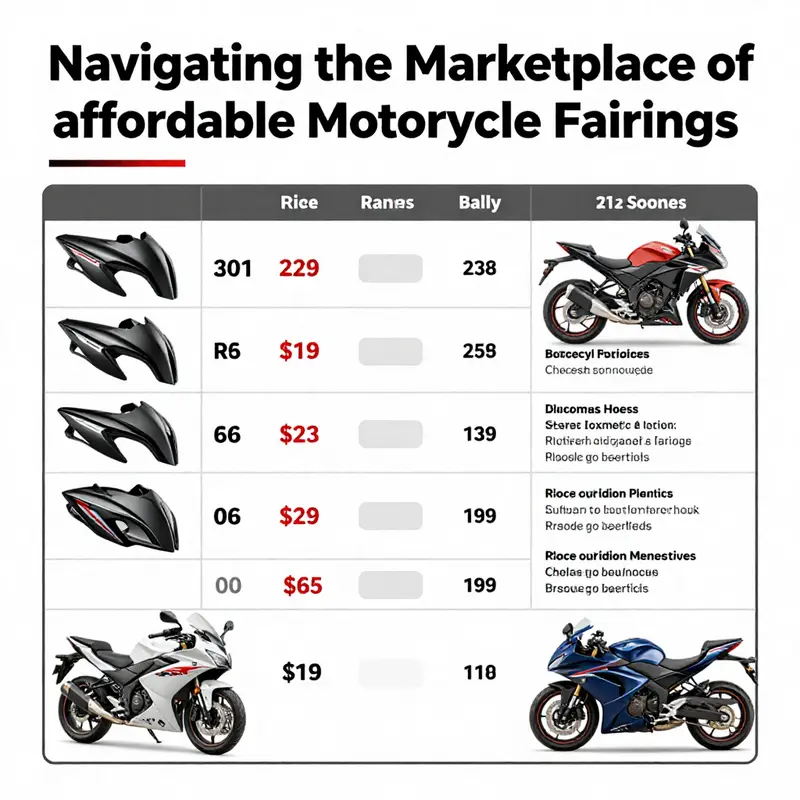
At the bottom end of the fairing market, the cheapest options share a common goal: mass production, quick availability, and low unit cost. These pieces are typically designed to cover generic front and rear contours for a broad range of bikes rather than to mirror any single model. The result is affordable price tags often in the 20s to 40s USD for a front fairing or a basic kit, at the expense of perfect fit, robust mounting, and original surface fidelity.
Value in this tier is heavily dependent on compatibility and the willingness to accept trade offs. Universal fit typically means a limited range of mounting options, possible gaps between panels, and the need for extra hardware or trim work. The materials are usually ABS or basic polypropylene that crack more easily than premium variants, but can be serviceable for cosmetic updates or short term use.
Smart buying in this segment centers on verifying exact compatibility with your year and model, counting included hardware, and checking return policies. Reviews and seller notes can reveal how closely the piece aligns with typical bikes and whether color matching or surface finish requirements are reasonable given the price.
Longer term, customers who plan to ride regularly or with higher speeds may prefer to step up to mid range options that balance cost with durability and fit. Even within the cheapest tier, there is room to save by selecting kits that include mounting brackets and clear installation instructions, thereby reducing or eliminating the guesswork of installation.
The Price-Performance Spectrum: Consumer Insights on the Cheapest Motorcycle Fairings

This chapter examines how price affects value in motorcycle fairings. It compares OEM versus aftermarket options, discusses material choices such as ABS and PP blends, and explains how fitment, durability, and finish influence total cost of ownership.
Readers learn to balance upfront price with mounting compatibility, service life, and the practical needs of daily riding. Across markets in early 2026, the trend is clear: the cheapest options offer quick repairs and customization, but the long-run value depends on fit, finish, and reliable performance.
Shopping strategies include checking model-year fit notes, including mounting hardware in listings, and consulting user reviews to assess real-world fit. The chapter closes with guidance to treat price as a starting point in a broader value assessment rather than a sole deciding factor.
Final thoughts
As the motorcycle accessory market continues to evolve, understanding the nuances of the cheapest motorcycle fairings can empower business owners to make strategic decisions. By analyzing trends, materials, market comparisons, and consumer insights, businesses can position themselves to meet growing demands for affordable solutions without compromising quality. This knowledge not only enhances customer satisfaction but also drives profitability and competitive advantage in a saturated marketplace.